






I. 3 different ways to say Goodbye in Korean
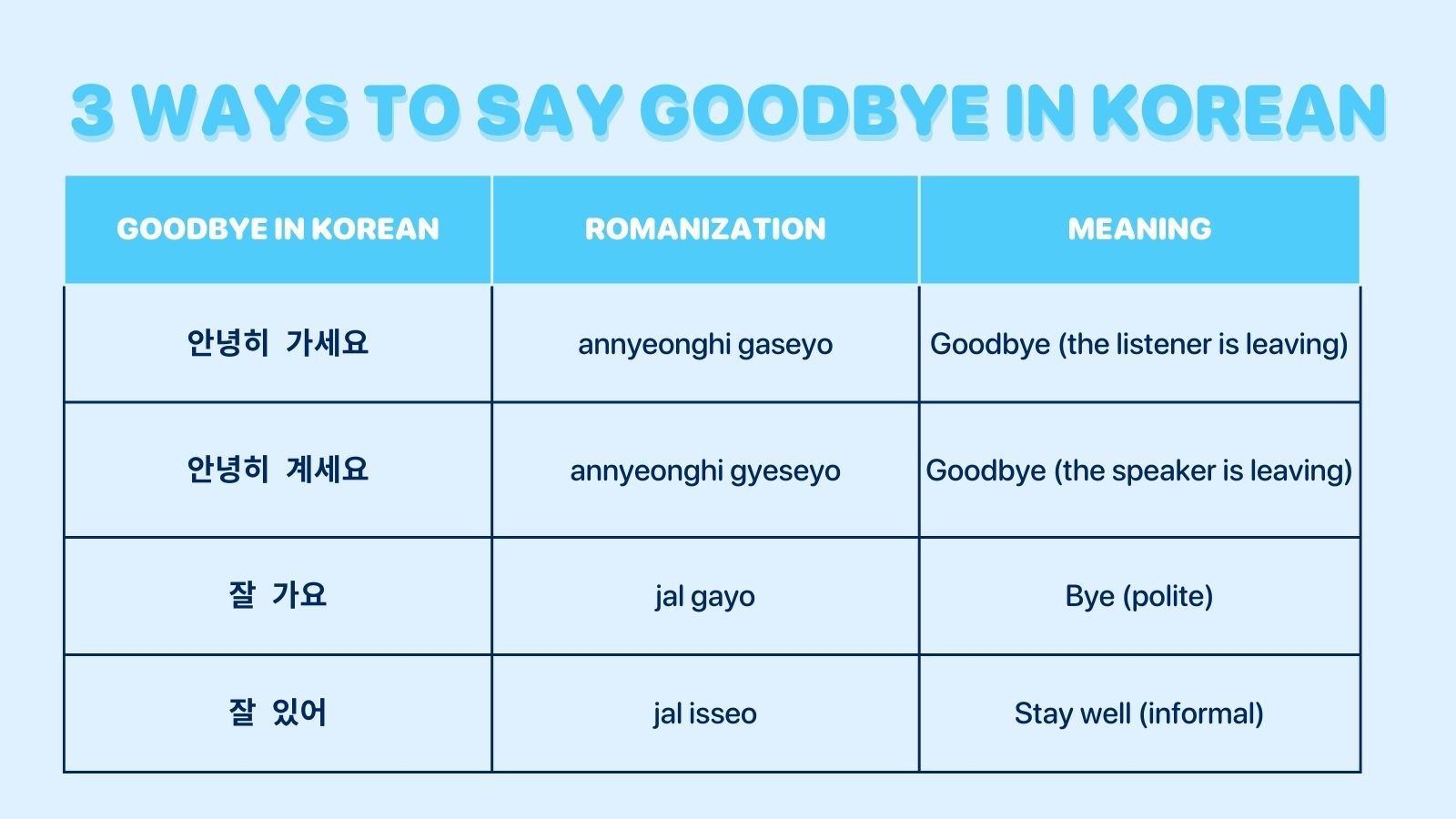
There are two most common Korean expressions are 안녕히 가세요 (Annyeonghi Gaseyo) and 안녕히 계세요 (Annyeonghi Gyeseyo). Below are the expressions categorized by formality.
1. Formal ways to say Goodbye in Korean
When speaking to elders, teachers, customers, or anyone you should show respect to, Korean uses highly formal expressions. These phrases help you sound polite, well-mannered, and culturally appropriate.
| Goodbye in Korean | Romanization | Meaning |
| 안녕히 가세요 | annyeonghi gaseyo | Goodbye (the listener is leaving) |
| 안녕히 계세요 | annyeonghi gyeseyo | Goodbye (the speaker is leaving) |
| 안녕히 주무세요 | annyeonghi jumuseyo | Good night (formal) |
| 평안히 가십시오 | pyeonganhi gasipsio | Very formal goodbye |
| 안녕히 돌아가십시오 | annyeonghi doragasipsio | Have a safe return |
2. Polite ways to say Goodbye in Korean
When the situation is friendly but still requires courtesy, such as with coworkers, acquaintances, or neighbors, Koreans use polite goodbye expressions. These phrases are versatile and suitable for everyday interactions.
| Goodbye in Korean | Romanization | Meaning |
| 잘 가요 | jal gayo | Bye (polite) |
| 잘 있어요 | jal isseoyo | Stay well (polite) |
| 다음에 봐요 | daeume bwayo | See you next time |
| 또 만나요 | tto mannayo | See you again |
3. Informal Korean Goodbyes
Among close friends, siblings, or people your age, casual expressions sound the most natural. Koreans switch to informal speech to show closeness, comfort, and friendliness.
| Goodbye in Korean | Romanization | Meaning |
| 잘 가 | jal ga | Bye (informal) |
| 잘 있어 | jal isseo | Stay well (informal) |
| 또 봐 | tto bwa | See you |
| 내일 봐 | naeil bwa | See you tomorrow |
| 다녀올게 | danyeoolge | I’m heading out (very casual) |
II. Related terms to express Goodbye in Korean
Korean offers many additional expressions that go beyond a simple “goodbye.” These phrases help you sound more natural and capture the nuance of real conversations. Below is a breakdown of commonly used farewell-related expressions.
1. “See you next time” in Korean
When you know you will meet someone again, Koreans often use friendly expressions that promise a future encounter. These phrases are common among friends, coworkers, and even polite situations.
| Goodbye in Korean | Romanization | Meaning |
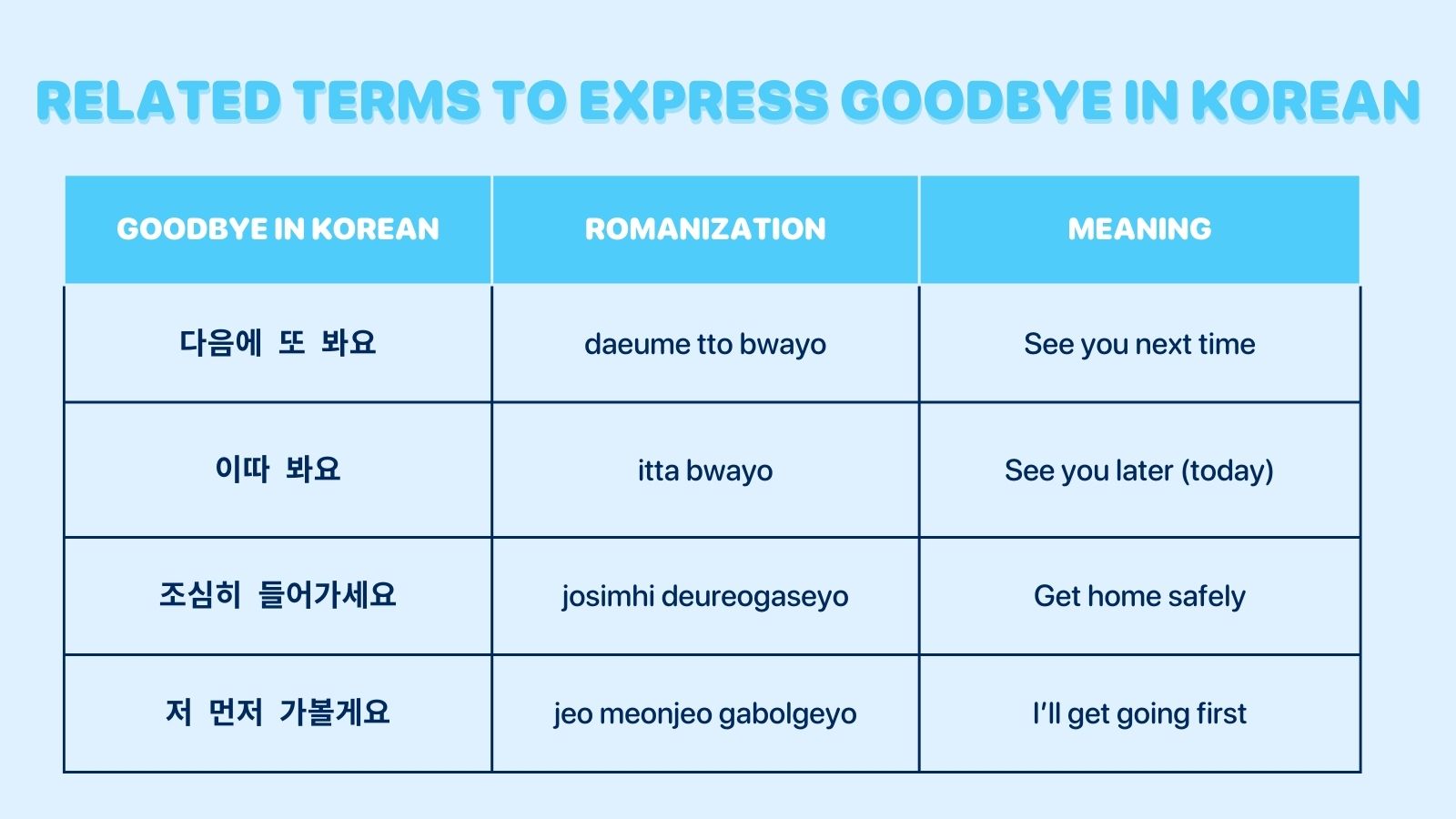
| 다음에 또 봐요 | daeume tto bwayo | See you next time |
| 다음에 봐요 | daeume bwayo | See you next time (polite) |
| 다음에 보자 | daeume boja | See you later (informal) |
| 또 봐요 | tto bwayo | See you again |
| 또 보자 | tto boja | See you (informal) |
| 이따 봐요 | itta bwayo | See you later (today) |
| 이따 봐 | itta bwa | See you later (informal) |
| 곧 봐요 | got bwayo | See you soon |
| 곧 보자 | got boja | See you soon (informal) |
2. “Have a safe trip” in Korean
Korean goodbyes often show care and warmth, especially when someone is traveling. These expressions are frequently used with friends, family, or even strangers when wishing them a safe journey.
| Goodbye in Korean | Romanization | Meaning |
| 조심히 가세요 | josimhi gaseyo | Go safely |
| 안전하게 가세요 | anjeonhage gaseyo | Travel safely |
| 조심히 들어가세요 | josimhi deureogaseyo | Get home safely |
| 무사히 다녀오세요 | musahi danyeo-oseyo | Have a safe trip and return safely |
| 잘 다녀오세요 | jal danyeo-oseyo | Have a good trip |
| 편안한 여행 되세요 | pyeonanhan yeohaeng doeseyo | Have a pleasant trip |
| 조심히 와 | josimhi wa | Come back safely (informal) |
| 잘 다녀와 | jal danyeowa | Have a good trip (informal) |
3. The “I’m leaving first” phrase in K-Dramas
If you watch K-dramas, you’ve probably heard characters saying they will “leave first.” These Korean phrases in K-Dramas are used when someone excuses themselves from a group or situation before others.
| Goodbye in Korean | Romanization | Meaning |
| 먼저 갈게요 | meonjeo galgeyo | I’ll go first |
| 저 먼저 가볼게요 | jeo meonjeo gabolgeyo | I’ll get going first |
| 먼저 가겠습니다 | meonjeo gagessseumnida | I will take my leave (formal) |
| 저 이만 가보겠습니다 | jeo iman gabogessseumnida | I should get going now |
| 먼저 가 | meonjeo ga | I’m leaving first (informal) |
| 나 먼저 간다 | na meonjeo ganda | I’m heading out first |
| 나 갈게 | na galge | I’ll go (informal) |
| 슬슬 가볼게요 | seulseul gabolgeyo | I’ll get going slowly / I’ll head out |
See also:
III. Common mistakes to avoid saying Goodbye in Korean
Even though Korean goodbyes seem simple at first, many learners make predictable mistakes that can affect how polite or natural they sound. Understanding these errors will help you avoid misunderstandings in real conversations.
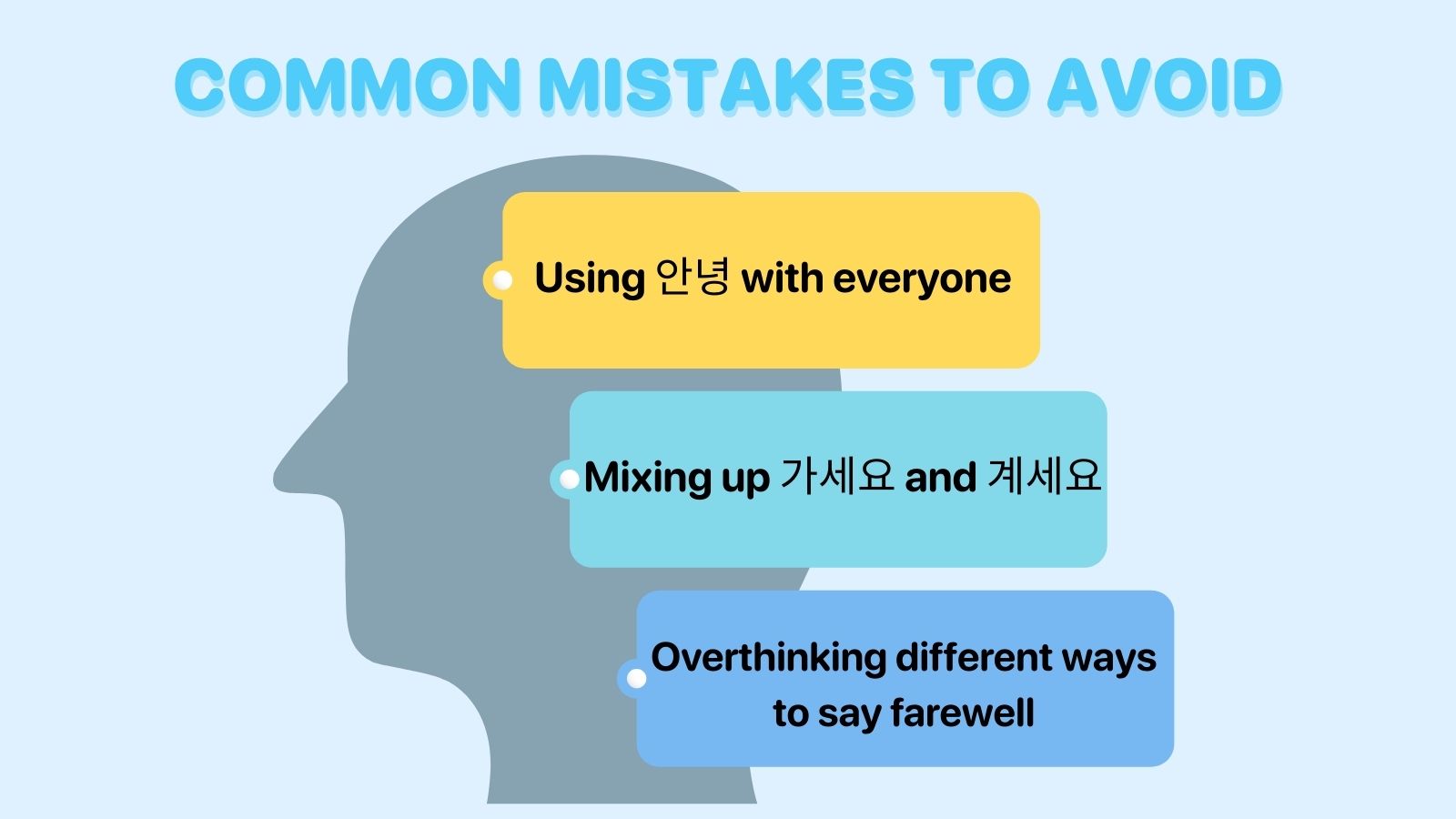
1. Using 안녕 with everyone
Many learners overuse 안녕, thinking it works in every situation. In reality, it is very informal and only suitable for close friends, same-age peers, or children. Using it with older people, coworkers, or strangers may sound disrespectful. Choosing the right level of politeness is key to sounding natural and culturally appropriate.
2. Mixing up 가세요 and 계세요
One of the most common mistakes is mixing up when to use each expression. 가세요 is used when the other person is leaving, while 계세요 is used when you are the one leaving. Confusing the two can make your goodbye sound awkward or even change the meaning entirely.
3. Overthinking different ways to say farewell
Korean has several levels of formality, which can overwhelm beginners. But the rule is simple: use formal expressions with elders, polite expressions with people you don’t know well, and informal expressions with close friends. Don’t worry too much about choosing the “perfect” phrase—natural communication matters more than strict perfection.
Conclusion
Mastering Goodbye in Korean goes beyond memorizing a few expressions. It’s about understanding when each phrase is appropriate based on social context, age, and relationships. With the 15+ expressions you’ve learned, you can confidently navigate real conversations and understand farewell scenes in K-dramas more easily. Keep practicing to build natural fluency.