







Phrasal verbs are an essential part of English communication. Phrasal verbs with “take” are some of the most frequently used expressions. When learning English, mastering these phrasal verbs can help improve both speaking fluency and listening comprehension.
In this guide, Gurulango will help you learn the meaning of phrasal verbs with take, explore 15 important phrasal verbs explained in detail, discover a list of other common phrasal verbs with take, and see practical examples of how these expressions are used in everyday conversations.
I. What Are Phrasal Verbs With Take?
A phrasal verb is a combination of a verb and a particle (a preposition or an adverb). When combined, the meaning of the phrase often becomes different from the original verb.
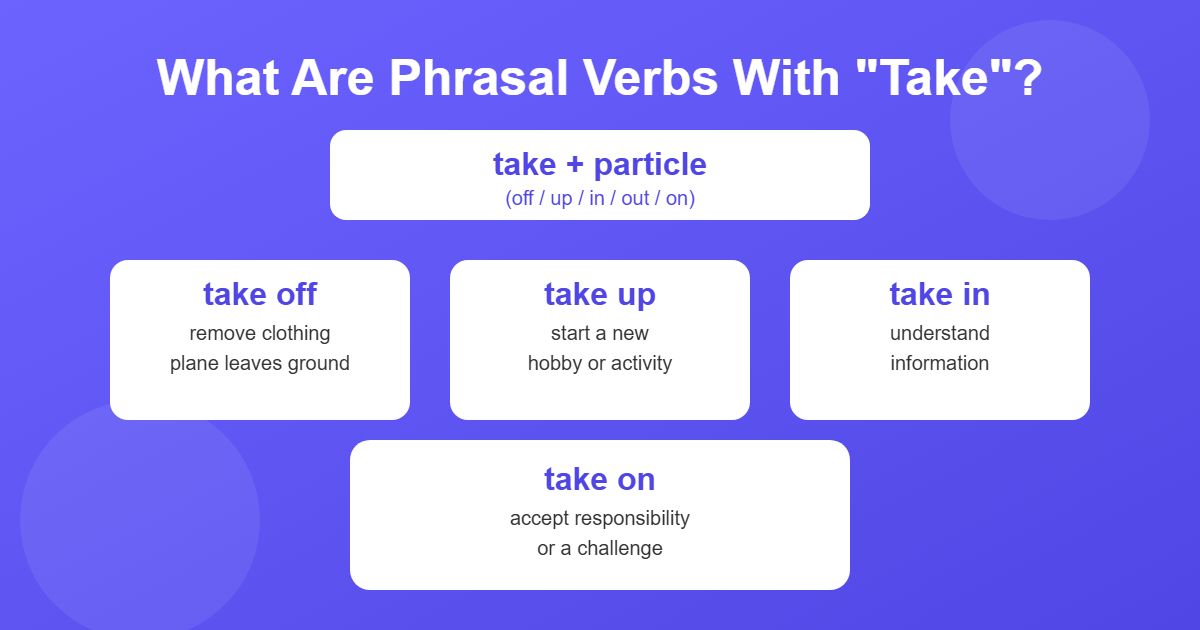
Structure: take + particle (off / up / in / out / on…)
Examples:
- take off: remove clothing / a plane leaves the ground
- take up: start a new hobby or activity
- take in: understand information
- take on: accept responsibility or a challenge
Because the meaning changes depending on the particle, learning common phrasal verbs requires understanding them as complete expressions rather than translating each word separately.
See also: Master 100+ Common Collocations in English
II. 15 Important Phrasal Verbs With Take
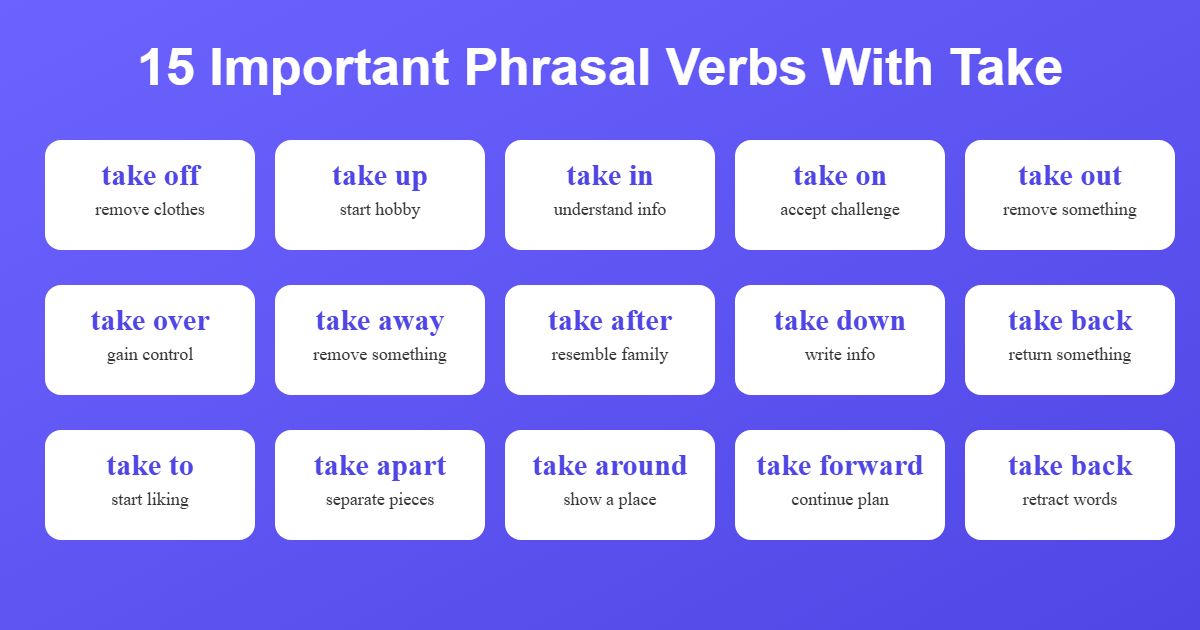
Below are some of the most important phrasal verbs with take that English learners should know.
1. Take Off
Meaning:
- Remove clothing
- A plane leaves the ground
- Become successful quickly
Examples:
- She took off her jacket.
- The plane took off at noon.
- His online business took off last year.
2. Take Up
Meaning:
- Start a new hobby or activity
- Occupy time or space
Examples:
- She took up photography.
- This table takes up too much space.
3. Take In
Meaning:
- Understand information
- Allow someone to stay in your home
Examples:
- It was difficult to take in everything he said.
- The family took in a homeless cat.
4. Take On
Meaning:
- Accept responsibility or a challenge
- Hire new employees
Examples:
- She took on a new role at work.
- The company plans to take on more staff.
5. Take Out
Meaning:
- Remove something
- Borrow money (loan)
Examples:
- He took out his phone.
- They took out a mortgage to buy a house.
6. Take Over
Meaning: Gain control of something such as a company or position.
Examples:
- A multinational company took over the startup.
- She will take over as manager next month.
7. Take Away
Meaning:
- Remove something
- Food ordered to eat elsewhere
Examples:
- The teacher took away his phone.
- We ordered Chinese takeaway for dinner.
8. Take After
Meaning: Resemble someone in your family.
Examples:
- She takes after her mother.
- He takes after his grandfather.
9. Take Down
Meaning:
- Write information
- Remove something from a higher place
Examples:
- Please take down my number.
- They took down the old poster.
10. Take Back
Meaning:
- Return something
- Retract something you said
Examples:
- I took back the shoes to the store.
- I take back what I said earlier.
11. Take To
Meaning: Start liking something or someone quickly.
Example: She took to her new job immediately.
12. Take Apart
Meaning: Separate something into pieces.
Example: He took apart the computer to fix it.
13. Take Around
Meaning: Show someone a place.
Example: She took me around the city.
14. Take Back (emotionally)
Meaning: Remind someone of the past.
Example: That song takes me back to my childhood.
15. Take Forward
Meaning: Continue developing something.
Example: The team will take forward the new strategy.
See also: Common Phrasal verb with Get
III. Other Common Phrasal Verbs With Take
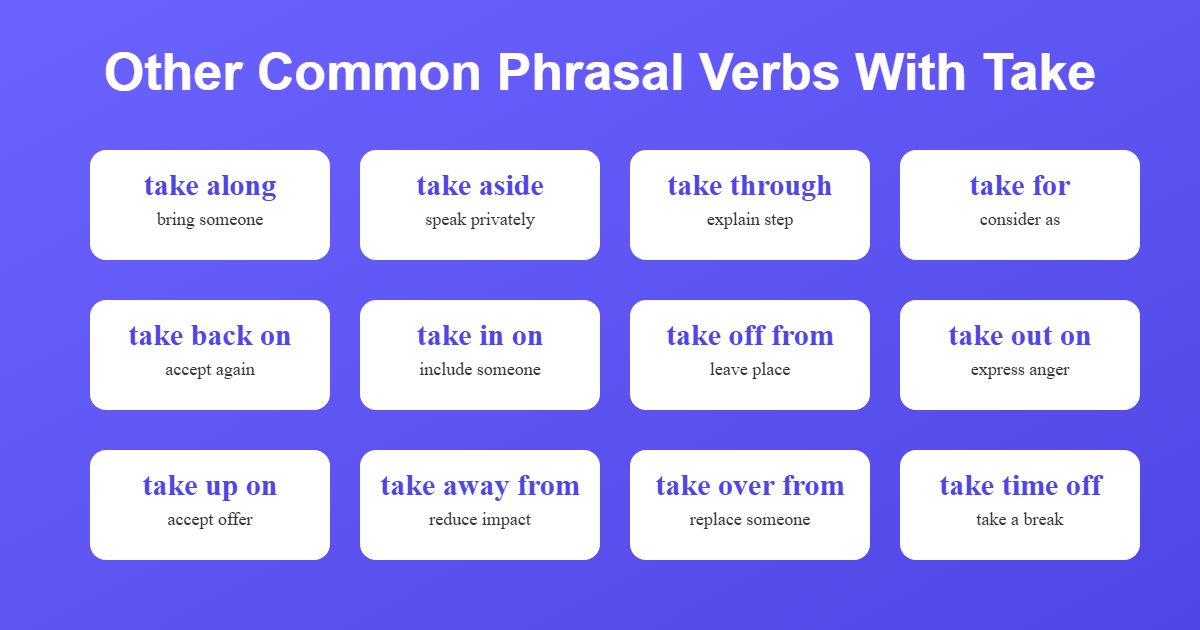
Besides the phrasal verbs above, there are several other expressions with take that appear frequently in English. The table below summarizes some additional examples.
| Phrasal Verb | Meaning | Example |
| take along | bring someone or something with you | She took her sister along to the party |
| take aside | speak to someone privately | The manager took him aside for a talk |
| take away from | reduce the importance of something | The mistake took away from the presentation |
| take back on | allow someone to return to a job or relationship | The company took him back on after a year |
| take for | consider someone to be something | I took him for a teacher |
| take in on | involve someone in an activity | They took me in on their plan |
| take off from | begin from a particular place | The plane took off from Hanoi |
| take out on | express anger toward someone | He took his frustration out on his friend |
| take through | explain something step by step | She took me through the process |
| take up on | accept an offer | He took her up on the invitation |
Learning these expressions will help expand your vocabulary and make your English sound more natural and fluent.
IV. Phrasal Verbs With Take in Everyday Conversation
Phrasal verbs appear frequently in daily conversations. Understanding how they are used in context will make them easier to remember.
1. Conversation Example 1
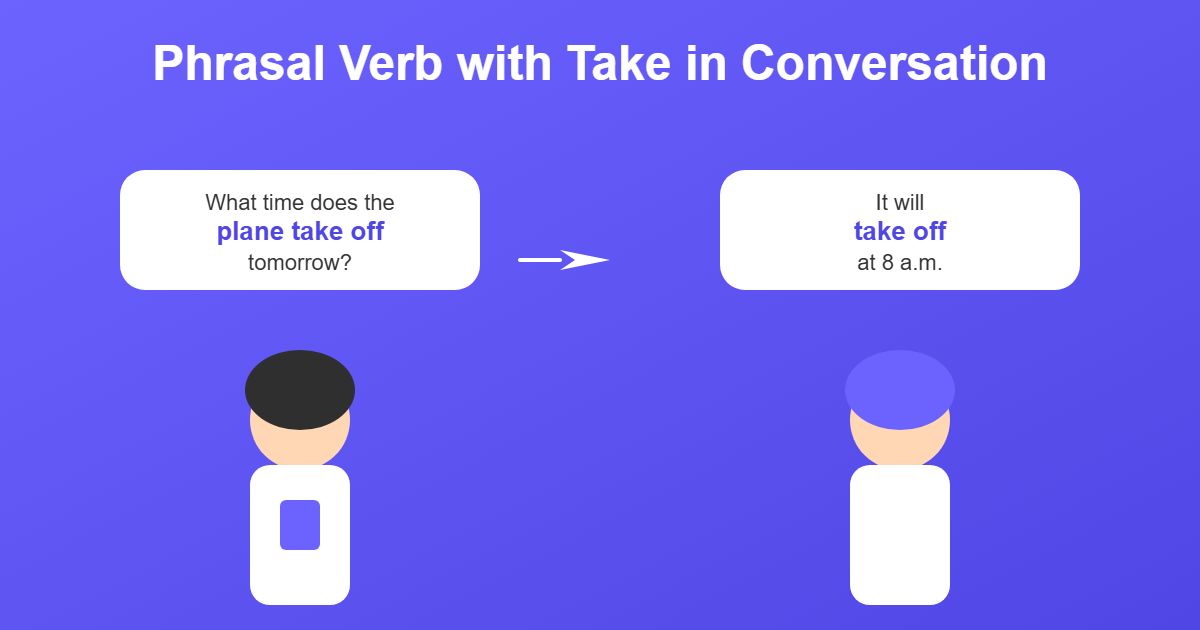
A: When does the plane take off?
B: It takes off at 9:30 tonight.
2. Conversation Example 2
A: Do you have any hobbies?
B: Yes, I recently took up painting.
3. Conversation Example 3
A: Who will lead the new project?
B: Maria will take on that responsibility.
4. Conversation Example 4
A: Can you take down my phone number?
B: Sure, go ahead.
5. Conversation Example 5
A: You look a lot like your mother.
B: Yes, everyone says I take after her.
Using these phrasal verbs regularly in conversation will help you sound more natural and confident when speaking English.
Mastering phrasal verbs with take is an important step toward speaking English more naturally. Expressions like take off, take up, take in, and take on appear frequently in everyday conversations, so learning them will help you understand native speakers and express yourself more confidently.
If you want to expand your vocabulary and improve your English step by step, you can explore more lessons on Gurulango, where topics such as phrasal verbs, idioms, and practical English expressions are explained in a simple and structured way.