






What Is Chinese Punctuation?
Chinese punctuation is called 标点符号 (biāodiǎn fúhào). Modern Chinese generally uses full-width punctuation marks, meaning each punctuation mark occupies approximately the same visual space as one Chinese character.
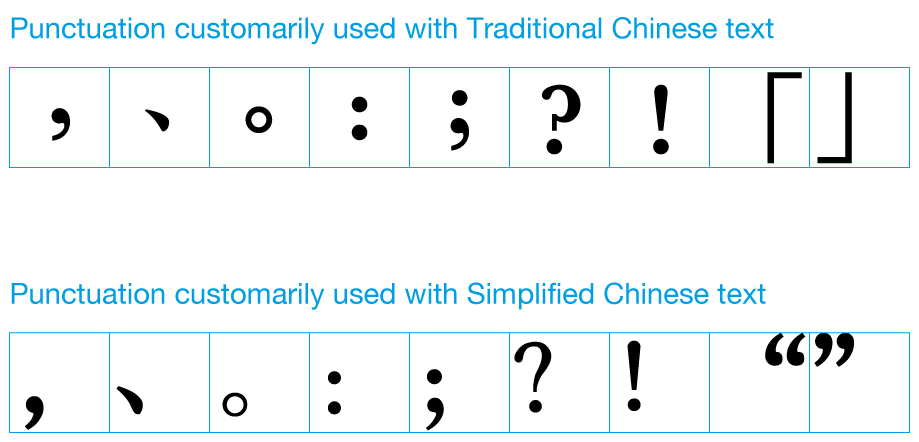
Many Chinese punctuation marks are similar to their English equivalents. For example, Chinese uses 。 to end a statement, ? for questions, and ! for exclamations. However, some punctuation marks have distinct functions or forms that learners need to recognize.
The most common Chinese punctuation marks include:
| Chinese Punctuation Mark | Name | English equivalent | Use |
| 。 | 句号 (jùhào) | Period | Ends a declarative sentence |
| , | 逗号 (dòuhào) | Comma | Separates clauses within a sentence |
| 、 | 顿号 (dùnhào) | Enumeration comma | Separates items in a list |
| ; | 分号 (fēnhào) | Semicolon | Links related independent clauses |
| : | 冒号 (màohào) | Colon | Introduces an explanation or list |
| ? | 问号 (wènhào) | Question mark | Ends a question |
| ! | 叹号 (tànhào) | Exclamation mark | Ends an exclamation |
| 「 」/『 』 | 引号 (yǐnhào) | Quotation marks | Direct speech, quoted text (traditional/Taiwan style) |
| “ ” | 引号 (yǐnhào) | Quotation marks | Direct speech, quoted text (simplified/mainland style) |
| 《 》 | 书名号 (shūmínghào) | Book title marks | Titles of books, films, songs, publications |
| 〈 〉 | 单书名号 (dān shūmínghào) | Single title marks | Titles nested inside 《 》, or short work titles |
| …… | 省略号 (shěnglüèhào) | Ellipsis | Omission or trailing off (always six dots) |
| —— | 破折号 (pòzhéhào) | Em dash | Sets off an explanation or sudden break |
Two habits worth noting for those who are learning Chinese: Chinese punctuation lists use the enumeration comma 、 instead of an ordinary comma, and full-width punctuation is typed with a full-width input method so each mark occupies its own character block rather than sitting flush against the text like English punctuation does.
9 Common Chinese Punctuation Marks Explained
1. The period 。句号
The Chinese period is written as 。, rather than the dot . commonly used in English.
This Chinese punctuation is used at the end of a declarative sentence.
Example:
我喜欢学中文。
Wǒ xǐhuān xué Zhōngwén.
I like studying Chinese.
Unlike the English period, the Chinese full stop is a small circle and normally occupies a full-width character position.
2. Chinese Comma ,逗号
The Chinese comma , is similar to the English comma and is used to separate clauses or parts of a sentence.
Example:
如果你有时间,我们一起学习中文。
Rúguǒ nǐ yǒu shíjiān, wǒmen yìqǐ xuéxí Zhōngwén.
If you have time, let’s study Chinese together.
Chinese uses the full-width comma ,, rather than the half-width English comma ,.
3. Enumeration Comma 、顿号
One of the most important differences between English and Chinese punctuation is the enumeration comma 、.
The enumeration comma is used to separate items in a list, particularly when the listed items are relatively short.
Example:
我喜欢苹果、香蕉、橙子和葡萄。
Wǒ xǐhuān píngguǒ, xiāngjiāo, chéngzi hé pútáo.
I like apples, bananas, oranges, and grapes.
The mark 、 should not simply be treated as another version of the regular comma. It specifically helps separate parallel items in an enumeration.
4. Chinese Semicolon ;分号
The semicolon ; connects closely related clauses or separates larger units within a sentence.
Example:
有些人喜欢早起;有些人喜欢晚上学习。
Some people like getting up early; others prefer studying at night.
5. Chinese Colon :冒号
The colon : is used to introduce an explanation, quotation, example, or list.
Example:
我需要买三样东西:书、笔和纸。
I need to buy three things: books, pens, and paper.
6. Chinese Question Mark ?问号
The Chinese question mark ? is used at the end of a question, just as in English.
Example:
你叫什么名字?
Nǐ jiào shénme míngzi?
What is your name?
7. Chinese Exclamation Mark !叹号
The exclamation mark ! expresses strong emotion, surprise, emphasis, or a command.
Example:
太好了!
Tài hǎo le!
That’s great!
8. Chinese Quotation Marks “ ” and 「 」
Chinese quotation marks vary according to the writing system and regional convention.
In Simplified Chinese, particularly in Mainland China, double quotation marks “ ” are commonly used for direct speech and quoted material.
Example:
他说:“我明天去北京。”
Tā shuō: “Wǒ míngtiān qù Běijīng.”
He said, “I’m going to Beijing tomorrow.”
When a quotation occurs inside another quotation, single quotation marks ‘ ’ are commonly used.
In Traditional Chinese, especially in Taiwan, corner quotation marks 「 」 are commonly used.
Example:
他說:「我明天去台北。」
Tā shuō: “Wǒ míngtiān qù Táiběi.”
He said, “I’m going to Taipei.”
For a quotation within a quotation, 『 』 can be used.
The exact convention can vary between Mainland China, Taiwan, Hong Kong, and Macau, so localization should follow the style guide of the target market.
9. Chinese Ellipsis …… and Em Dash ——
Chinese uses …… for an ellipsis. Unlike the standard three-dot form … commonly seen in English, the Chinese ellipsis consists of six dots and occupies two character spaces.
Example:
我不知道……
I don’t know…
The Chinese em dash is written as —— and can introduce an explanation, interruption, change in thought, or additional information.
Example:
他终于来了——我们等了他两个小时。
He finally arrived—we had been waiting for him for two hours.
Simplified vs. Traditional Chinese Punctuation
Chinese punctuation is generally very similar in Simplified and Traditional Chinese. Most punctuation marks, including the full stop 。, comma ,, enumeration comma 、, question mark ?, exclamation mark !, colon :, semicolon ;, ellipsis ……, parentheses ( ), and book-title marks 《 》, are used in both systems.
The main difference is quotation marks
In Simplified Chinese, especially in Mainland China, Chinese punctuation such as double quotation marks are usually written as “ ”, with single quotation marks ‘ ’ used for quotations within quotations.
Example:
他说:“她告诉我‘谢谢你’。”
In Traditional Chinese, particularly in Taiwan, corner quotation marks are commonly used: 「 」, with 『 』 used for a quotation within a quotation.
Example:
他說:「她告訴我『謝謝你』。」
Traditional Chinese punctuation can vary by region. Taiwan, Hong Kong, and Macau may follow different style conventions, so for localization, it is better to consider the target locale rather than treating Traditional Chinese as one universal standard.
Another general difference is spacing
Chinese normally does not put spaces between words:
我喜欢学习中文。
Not:
我 喜欢 学习 中文。
However, spaces can appear around Latin letters, numbers, or for specific formatting purposes.
What Are Chinese Book Title Marks 《 》?
《 》 are called 书名号 (shūmínghào), or Chinese book title marks.
They are used to mark the titles of complete works, including books, novels, films, television programs, songs, newspapers, magazines, and other named works.
For example:
我正在看《西游记》。
Wǒ zhèngzài kàn 《Xīyóu Jì》.
I’m reading Journey to the West.
In English, titles may be distinguished using italics or quotation marks. Chinese commonly uses 《 》 for this purpose.
Chinese also has the single title marks 〈 〉, which can be used for titles nested within another title in contexts where the relevant style convention calls for them.
How to write 1, 2, 3, 4, 5, 6, 7, 8, 9, 10 in Chinese
Chinese numbers are relatively systematic. Once you learn the numbers from one to ten, you can form many larger numbers by combining them.
| Number | Character | Pinyin |
| 1 | 一 | yī |
| 2 | 二 | èr |
| 3 | 三 | sān |
| 4 | 四 | sì |
| 5 | 五 | wǔ |
| 6 | 六 | liù |
| 7 | 七 | qī |
| 8 | 八 | bā |
| 9 | 九 | jiǔ |
| 10 | 十 | shí |
Once you know 一 through 十, higher numbers build logically: 11 is 十一 (ten-one), 12 is 十二 (ten-two), and 20 is 二十 (two-ten). This decimal-style pattern continues predictably all the way to 99, which makes Chinese numerals easier to pick up than they first appear.
二 vs 两
Both 二 (èr) and 两 (liǎng) mean “two,” and mixing them up is one of the most common early mistakes for learners. The rule comes down to context, not meaning:
- Use 二 for counting in sequence, in math, in multi-digit numbers, and for ordinal contexts like page numbers, dates, or bus routes: 二十 (20), 二〇二六年 (year 2026), 第二 (second/number two).
- Use 两 when a measure word or classifier follows, to specify a quantity of two things: 两个人 (two people), 两本书 (two books), 两杯水 (two cups of water).
A useful shortcut: if a measure word (个, 本, 杯, 只, etc.) comes right after the number, reach for 两. If you’re counting, dialing a number, or stating a date or ranking, use 二.
Examples:
二十 = 20
二〇二六年 = 2026
第二 = second
两 is commonly used before measure words or classifiers when referring to a quantity of two.
Examples:
两个人 = two people
两本书 = two books
两杯水 = two cups of water
A useful beginner rule is: when two comes directly before a classifier or measure word, 两 is often the natural choice.
Example:
我有两个孩子。
Wǒ yǒu liǎng gè háizi.
I have two children.
However, this is a useful rule rather than an absolute one. 二 and 两 have additional usage patterns, so advanced learners should learn them according to context.
Conclusion
Understanding Chinese punctuation is an important step toward reading and writing Chinese more naturally. If you want to expand your Chinese vocabulary and remember new words more effectively, GuruLango can help. With spaced repetition and an AI-powered learning path, you can review vocabulary at the right time and practice consistently without feeling overwhelmed. Start learning Chinese with GuruLango and make every new word easier to remember.
FAQs
What punctuation does Chinese use?
Chinese uses full-width punctuation marks including the period 。, comma ,, enumeration comma 、, semicolon ;, colon :, question mark ?, exclamation mark !, quotation marks “ ” or 「 」, book title marks 《 》, ellipsis ……, and em dash ——. Several of these, like the enumeration comma and book title marks, have no direct English equivalent.
What is 《 》 used for?
《 》are book title marks used to enclose the titles of complete works — books, films, TV shows, albums, newspapers, and official documents — the way English uses italics or quotation marks for titles.
How to write 1, 2, 3, 4, 5, 6, 7, 8, 9, 10 in Chinese?
They are written as 一 (1), 二 (2), 三 (3), 四 (4), 五 (5), 六 (6), 七 (7), 八 (8), 九 (9), and 十 (10). Numbers above ten build on these by combining them, e.g. 十一 for 11.
What’s the difference between 二 and 两?
二 (èr) is used for counting, math, multi-digit numbers, and ordinal contexts. 两 (liǎng) is used specifically before a measure word to describe a quantity of two objects, such as 两个人 (two people).
What is the difference between English and Chinese punctuation?
Chinese commonly uses full-width punctuation marks, such as 。 instead of ., , instead of ,, and ? instead of ?. Chinese also uses punctuation marks such as 、 and 《 》 that have no direct equivalent in standard English punctuation.