







What is Chinese slang?
Chinese slang is informal, fast-changing language used in everyday conversations, especially among younger speakers. It includes internet phrases, abbreviations, number codes, and playful expressions.
Compared to standard Mandarin, slang is less about strict grammar and correctness, and more about speed, emotion, and creativity. Speakers often rely on wordplay, similar sounds, or shortened forms to express ideas quickly and naturally.
You’ll see Chinese slang both offline and online, but most of it is shaped by internet trends and Gen Z culture. New terms often start on platforms like Weibo or Douyin, spread quickly, and then make their way into daily conversations.
Why Chinese slang matters for learners?
You might feel confident with textbook Chinese, but once you step into real conversations or social media, things suddenly don’t make sense. If you want to learn Chinese properly, slang is something you can’t ignore.

- Natural-sounding communication: Textbook Chinese often feels polite but distant. Slang helps you match how native speakers actually speak, especially in casual situations.
- Real-world comprehension (social media & videos): Platforms like Weibo, Douyin, or livestream chats are full of slang. Without it, you may understand the words but miss the meaning or tone entirely.
- Faster, more intuitive expression: Many slang terms are based on numbers, abbreviations, or wordplay. Once you understand the pattern, they’re quicker to recall and use than longer standard phrases.
- Cultural awareness (trends, mindset, Gen Z culture): Slang reflects what people care about right now, from workplace pressure to online humor. It helps you understand not just the language, but how people actually think and react.
60+ most useful Chinese slang words you should know
If you want to understand real Chinese, this is where it starts. These are the most common slang words grouped by how they’re actually used, so you can learn them in context and recognize them instantly.
Chinese Internet slang
Scroll through Chinese social media for a few minutes, and you’ll see people using words that never appear in textbooks. Here are some of the most common ones:
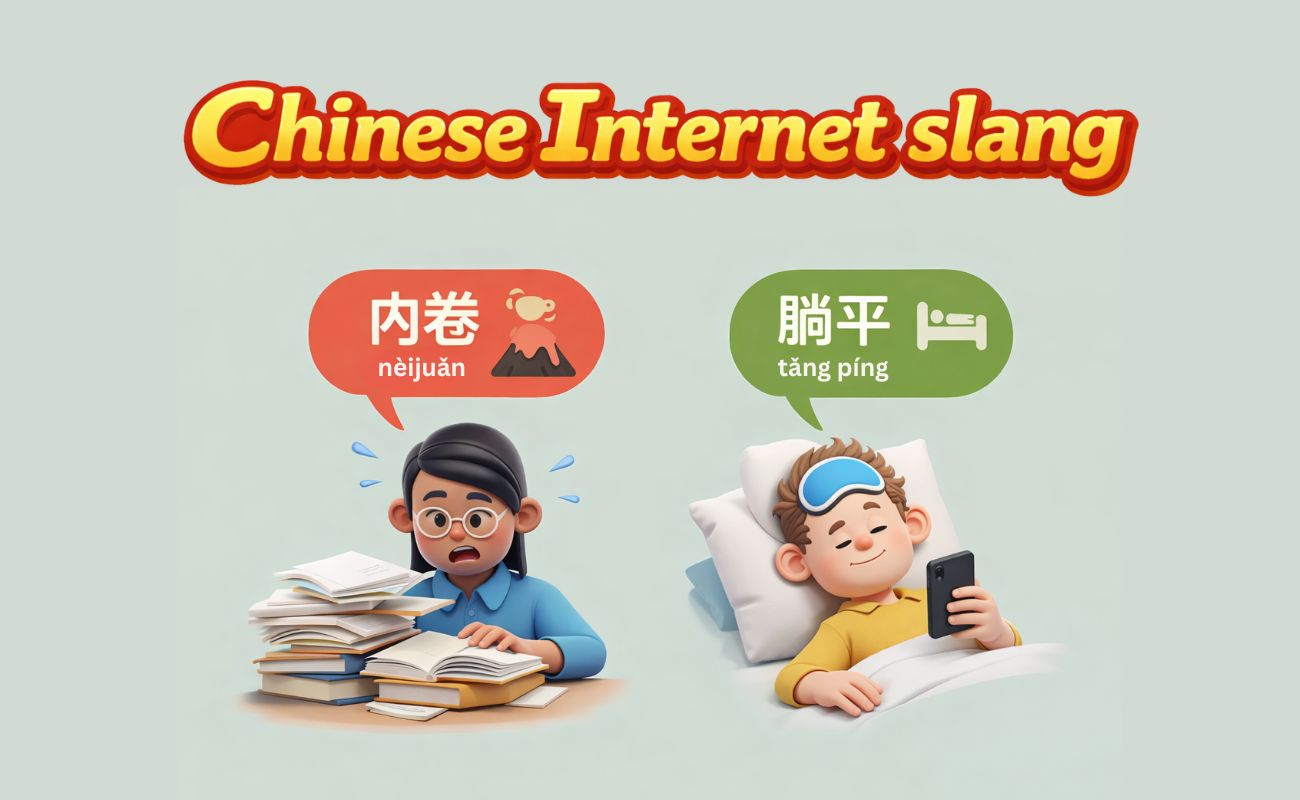
- 内卷 (nèijuǎn): intense competition where everyone works harder but gains little
Example: 现在公司太内卷了。(Work has become overly competitive.)
- 躺平 (tǎng píng): choosing to stop competing and just meet the minimum
Example: 他决定躺平,不想再加班了。(He chose to stop competing and avoid overtime.)
- 吃瓜 (chī guā): watching drama or gossip as a bystander
Example: 我只是来吃瓜的。 (I’m just here for the drama.)
- 摆烂 (bǎi làn): giving up and doing things carelessly on purpose
Example: 他已经开始摆烂了。(He’s given up trying.)
- 社死 (shè sǐ): extremely embarrassing in a social situation
Example: 在大家面前说错话,直接社死。 (I said the wrong thing in front of everyone, so embarrassing.)
- 破防了 (pò fáng le): emotionally overwhelmed or suddenly triggered
Example: 这段话让我直接破防了。(That line really hit me.)
- 柠檬精 (níng méng jīng): someone who feels jealous of others’ success or happiness
Example: 看到他们旅行,我又变成柠檬精了。(Seeing their trip made me jealous again.)
- 凡尔赛 (fán ěr sài): humblebragging in an indirect way
Example: 别再凡尔赛了。(Stop humblebragging.)
- 我太难了 (wǒ tài nán le): life is hard (often said humorously)
Example: 每天加班,我太难了。(Working overtime every day… life is hard.)
- 你行你上 (nǐ xíng nǐ shàng): “if you think you can do it, then do it yourself” (used to challenge someone)
Example: 你行你上啊。(If you can do it, go ahead.)
Chinese slang using numbers
You’ll often see numbers in Chinese chats that seem meaningless at first. In reality, they work because of how similar they sound to full Chinese phrases when spoken aloud.
- 520 (wǔ èr líng): “I love you”
Approximates 我爱你 (wǒ ài nǐ) through similar sounds and rhythm. - 1314 (yī sān yī sì): “forever”
Reflects 一生一世 (yī shēng yī shì), preserving the four-syllable structure. - 886 (bā bā liù): “bye-bye”
Based on bā bā, which resembles the borrowed sound “bye-bye” in Chinese. - 88 (bā bā): “bye”
A shorter form using the same phonetic logic.
See also: Say goodbye in Chinese
- 233 (èr sān sān): laughter
Originated from early Chinese forums and is widely understood as 哈哈哈 (hā hā hā), similar to “lol.” - 555 (wǔ wǔ wǔ): crying
Mimics 呜呜呜 (wū wū wū), the onomatopoeic sound of sobbing. - 995 (jiǔ jiǔ wǔ): “help me”
Matches the pronunciation of 救救我 (jiù jiù wǒ). - 530 (wǔ sān líng): “I miss you”
Based on approximate similarity to 我想你 (wǒ xiǎng nǐ). - 748 (qī sì bā): “go away” or “get lost”
Derived from 去死吧 (qù sǐ ba); informal and potentially offensive. - 996 (jiǔ jiǔ liù): a work schedule (9 am-9 pm, 6 days a week)
Unlike others, this is not phonetic substitution but a direct numeric representation of working hours.
Chinese slang abbreviations (letters & initials)
Chinese internet slang also relies heavily on shortened forms. Instead of writing full phrases, people use initials from pinyin or mix letters and numbers to compress meaning into just a few characters.
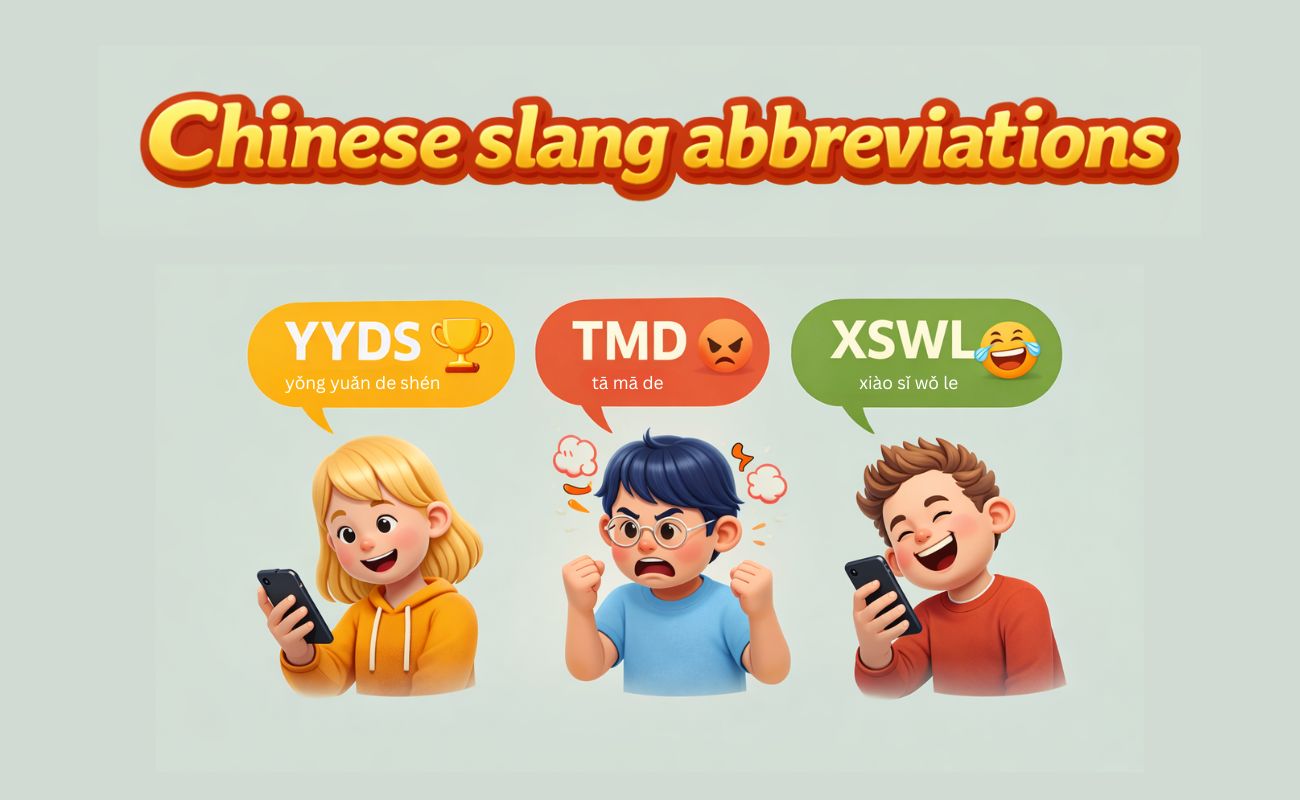
- YYDS (yǒng yuǎn de shén): “the greatest of all time”
Formed from the initials of 永远的神. - TMD (tā mā de): a strong expression of frustration
From 他妈的; informal and vulgar. - DBQ (duì bù qǐ): “sorry”
Initials of 对不起. - XSWL (xiào sǐ wǒ le): “I’m dying of laughter”
From 笑死我了. - QSWL (qì sǐ wǒ le): “I’m so angry”
From 气死我了. - U1S1 (yǒu yī shuō yī): “to be honest”
A hybrid form representing 有一说一, combining letters and numbers. - HHH (hā hā hā): laughter
A direct abbreviation of 哈哈哈. - CP (xī pī): a romantic pairing
Borrowed from English “couple,” common in fandom culture. - CP粉 (xī pī fěn): fans who support a pairing
Combines “CP” with 粉 (fan). - NB (niú bī): “impressive” or “powerful”
A shortened form of 牛逼; informal usage.
Everyday Chinese slang
Even if you avoid internet slang, you’ll still hear these expressions in daily conversations. They’re simple, widely used, and often the difference between sounding natural and sounding textbook.
- 宅 (zhái): someone who prefers staying at home and avoids social activities
Derived from the original meaning “residence,” now used to describe a homebody. - 佛系 (fó xì): having a laid-back, “let it be” attitude
Comes from Buddhist philosophy, implying low attachment and low stress. - 靠谱 (kào pǔ): reliable, trustworthy
Common in everyday evaluation of people or situations. - 不靠谱 (bù kào pǔ): unreliable, not dependable
Direct negation of 靠谱. - 给力 (gěi lì): effective, impressive, “delivers results”
Originally from online usage, now fully integrated into daily speech. - 拉黑 (lā hēi): to block someone (on social media or messaging apps)
Literally “pull into blacklist.” - 吐槽 (tǔ cáo): to complain humorously or criticize casually
Often used when pointing out something annoying in a light tone. - 神了 (shén le): amazing, unbelievable
Suggests something is almost “god-like” in ability. - 尴尬 (gān gà): awkward or embarrassing
Frequently used in social situations. - 随便 (suí biàn): “whatever,” “anything is fine”
Depends heavily on context; can signal flexibility or indifference.
Workplace & lifestyle Chinese slang
A lot of modern Chinese slang comes from work culture and everyday pressure. If you understand these, you’ll start to see how people talk about real life, not just language.
- 打工人 (dǎ gōng rén): working-class employee, often used self-referentially
Emphasizes shared struggle in modern work life. - 加班狗 (jiā bān gǒu): someone who works excessive overtime
The word 狗 adds a self-deprecating tone. - 摸鱼 (mō yú): to slack off or avoid work while on the job
Literally “to fish,” implying doing something unrelated during work hours. - 搬砖 (bān zhuān): to work hard at repetitive, low-level tasks
Literally “carry bricks,” a metaphor for labor-intensive work. - 007 (líng líng qī): working all day, every day (24/7 schedule)
Extends the idea of overwork beyond standard hours. - 精致穷 (jīng zhì qióng): appearing to live well despite being financially strained
Describes lifestyle spending beyond one’s means. - 月光族 (yuè guāng zú): people who spend their entire monthly salary
Literally “moonlight clan,” meaning no savings left. - 副业 (fù yè): side job or secondary income stream
Increasingly common in modern urban life. - 内耗 (nèi hào): internal mental drain or overthinking
Often used to describe emotional exhaustion. - 躺赚 (tǎng zhuàn): earning money easily with little effort
Implies passive or effortless income.
Emotion & reaction Chinese slang
In real conversations, people don’t explain how they feel; they react. These expressions are short, direct, and used constantly in speech and online.
- 无语 (wú yǔ): speechless, frustrated to the point of having nothing to say
Often used when something is unreasonable. - 绝了 (jué le): extremely good or extremely ridiculous (depends on context)
Used for strong reactions. - 崩溃 (bēng kuì): emotionally overwhelmed, on the verge of breakdown
Common in stressful situations. - 离谱 (lí pǔ): absurd, unreasonable
Used when something goes beyond normal expectations. - 上火 (shàng huǒ): irritated or stressed (originally refers to physical imbalance)
Now widely used metaphorically. - 心累 (xīn lèi): mentally exhausted
Focuses on emotional rather than physical fatigue. - 看不懂 (kàn bù dǒng): “I don’t get it,” often implying confusion or disbelief
Common in reaction to strange situations. - 有点东西 (yǒu diǎn dōng xi): “there’s something there,” meaning unexpectedly impressive
Often used to praise subtly. - 太真实了 (tài zhēn shí le): “too real,” highly relatable
Used when something reflects real-life experience. - 离大谱 (lí dà pǔ): extremely absurd
A stronger version of 离谱.
How to learn Chinese slang as a language learner
Chinese slang is highly context-dependent and changes quickly. Instead of trying to memorize isolated terms, focus on how and where these expressions are actually used.
- Follow Douyin and Weibo for real-time usage: Most slang originates and spreads on these platforms. Pay attention to captions, comment sections, and repeated phrases within trending content to identify patterns of use.
- Watch dramas and livestreams for context and tone: Slang is rarely explained directly. Dramas show how expressions fit into specific situations, while livestreams reveal spontaneous, unscripted usage.
- Use flashcards with full examples, not single words: Slang depends heavily on context. Store complete sentences or short dialogues to understand nuance, tone, and appropriateness.
- Practice with native speakers to refine usage: Not all slang fits every situation. Regular interaction helps you learn what sounds natural, what feels outdated, and what may be inappropriate in certain contexts.
Conclusion
Chinese slang is the difference between understanding Chinese and actually feeling it. Once you start picking it up, real conversations stop sounding confusing and start making sense. Don’t try to memorize everything; focus on how it’s used. Want more practical, real-world language tips like this? Explore more about Gurulango and keep learning how people actually speak.
FAQs
1. What is the most common Chinese slang?
There is no single most common term, but 666 (liù liù liù) is one of the most widely used Chinese slang expressions. It means “awesome” or “impressive” and appears frequently in gaming, social media, and casual conversations.
2. What does YYDS mean in Chinese slang?
YYDS (yǒng yuǎn de shén) stands for 永远的神, meaning “the greatest of all time.” It is commonly used to praise someone or something as unbeatable.
3. What does 233 mean in Chinese slang?
233 (èr sān sān) represents laughter, similar to “lol.” It originated from Chinese online forums and is now widely used in comments and chats.
4. Are there Chinese slang swear words?
Yes. Chinese slang includes swear words such as TMD (tā mā de), which express strong frustration. These terms are informal and should be avoided in formal or professional contexts.