






I. What is DELF? Who Should Take DELF Exam?
DELF stands for Diplôme d’Études en Langue Française, which translates to Diploma in French Language Studies. It is an official French language diploma designed to certify the French proficiency of non-native speakers according to the Common European Framework of Reference for Languages (CEFR). The DELF consists of four independent diplomas that correspond to the first four CEFR levels:
- DELF A1
- DELF A2
- DELF B1
- DELF B2
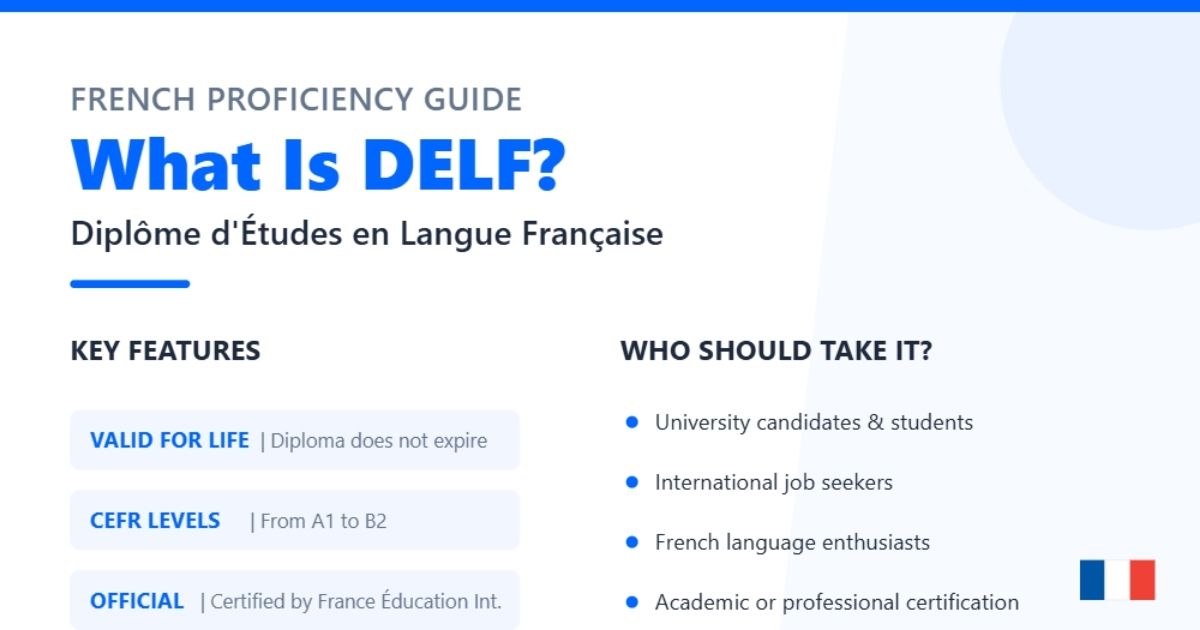
A DELF certificate is the official diploma awarded to candidates who successfully pass one of the DELF examinations. Unlike many standardized language tests, the DELF certificate does not expire. Once you earn a DELF diploma, it remains valid for life.
According to France Éducation International, the DELF Tout Public version is intended for adults and older teenagers, regardless of nationality, who wish to certify their French language skills for personal, academic, or professional purposes.
You may benefit from taking the DELF if you are:
- learning French as a foreign language;
- preparing for university studies;
- seeking internationally recognized proof of your French proficiency;
- applying for jobs where French language skills are required;
- pursuing long-term personal or professional goals involving French.
For younger learners, France Éducation International also offers DELF Prim (children) and DELF Junior/Scolaire (teenagers). Although the exam topics are adapted for younger candidates, these diplomas have the same official value as the standard DELF diploma.
DELF Levels Explained (A1–B2)
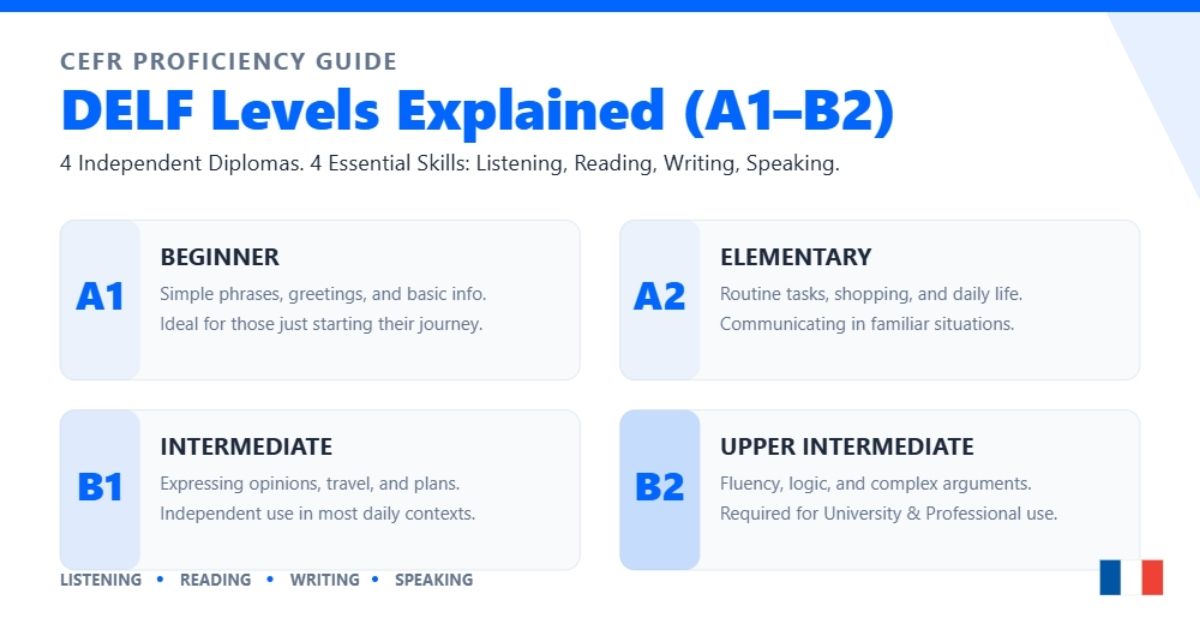
Unlike some language tests that provide a score covering multiple proficiency levels, the DELF consists of four independent diplomas. Each diploma assesses a candidate’s ability to use French at a particular CEFR level.
| DELF Diploma | CEFR Level | Language Ability |
| DELF A1 | A1 | Beginner |
| DELF A2 | A2 | Elementary |
| DELF B1 | B1 | Intermediate |
| DELF B2 | B2 | Upper Intermediate |
Each diploma evaluates the four essential language skills:
- Listening
- Reading
- Writing
- Speaking
The difficulty and expectations increase gradually from A1 to B2.
1. DELF A1
DELF A1 is the first level of the DELF qualification and is designed for complete beginners. At this level, candidates are expected to understand and use familiar everyday expressions and simple phrases. They should be able to introduce themselves, ask and answer basic personal questions, and communicate in simple situations when the other person speaks slowly and clearly. Candidates can usually:
- introduce themselves;
- greet others and exchange basic information;
- ask simple questions;
- understand short announcements;
- complete simple forms;
- write short messages or postcards.
Who should take DELF A1? DELF A1 is suitable for learners who have recently started studying French and want official recognition of their basic communication skills.
2. DELF A2
DELF A2 represents the elementary stage of French proficiency. Learners at this level can handle routine communication in familiar situations and understand frequently used expressions related to daily life.Candidates are generally able to:
- describe their family, education, and work;
- understand simple conversations;
- communicate during shopping, travel, and daily activities;
- write short personal letters;
- describe past experiences using simple language.
Who should take DELF A2? This level is appropriate for learners who have already built a basic foundation in French and want to demonstrate greater independence in everyday communication.
3. DELF B1
DELF B1 marks the transition from elementary to independent language use. At this level, learners are expected to communicate with greater confidence in most everyday situations. Candidates can generally:
- understand the main points of clear spoken and written French;
- describe experiences and future plans;
- explain opinions and preferences;
- deal with situations encountered while travelling;
- write connected texts on familiar topics.
Compared with A2, B1 requires candidates to express ideas more clearly and support their opinions with simple explanations.
Who should take DELF B1? DELF B1 is suitable for learners who can already communicate independently in everyday situations and wish to certify an intermediate level of French.
4. DELF B2
DELF B2 is the highest level available within the DELF qualification. At this stage, candidates should be able to communicate effectively and spontaneously in a wide variety of academic, professional, and social contexts. Candidates are expected to:
- understand complex texts;
- follow extended discussions;
- express ideas fluently and spontaneously;
- defend opinions using logical arguments;
- write well-structured texts on a wide range of topics.
The B2 examination places greater emphasis on reasoning, organization of ideas, and communicative effectiveness than on memorized grammar alone.
Who should take DELF B2?
DELF B2 is often chosen by learners preparing for university studies, professional opportunities, or situations requiring a higher level of French proficiency. Applicants should always check the language requirements of their chosen university or organization, as admission criteria may vary.
DELF Exam Format
The DELF exam is designed to assess your ability to communicate effectively in French in real-life situations. Regardless of the level you choose (A1, A2, B1, or B2), every DELF examination evaluates the same four core language skills:
- Listening
- Reading
- Writing
- Speaking
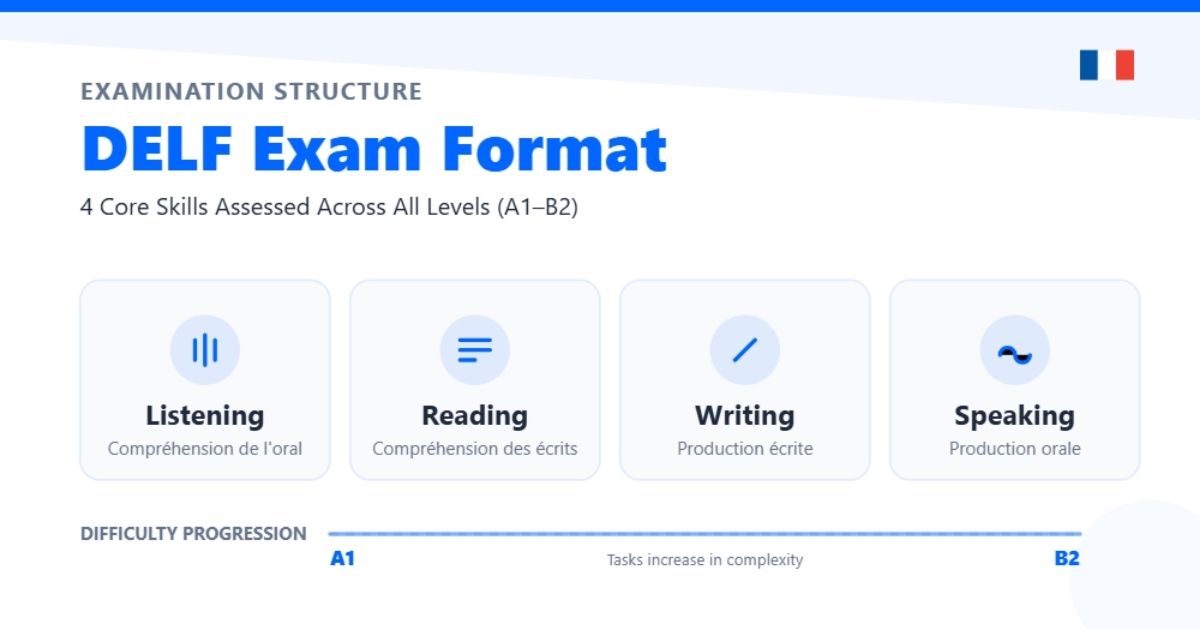
These four skills reflect the communicative approach of the Common European Framework of Reference for Languages (CEFR) and provide a balanced assessment of your overall French proficiency.
Although the exam format remains consistent across all DELF levels, the difficulty of the tasks increases as you progress from A1 to B2.
DELF Exam Structure
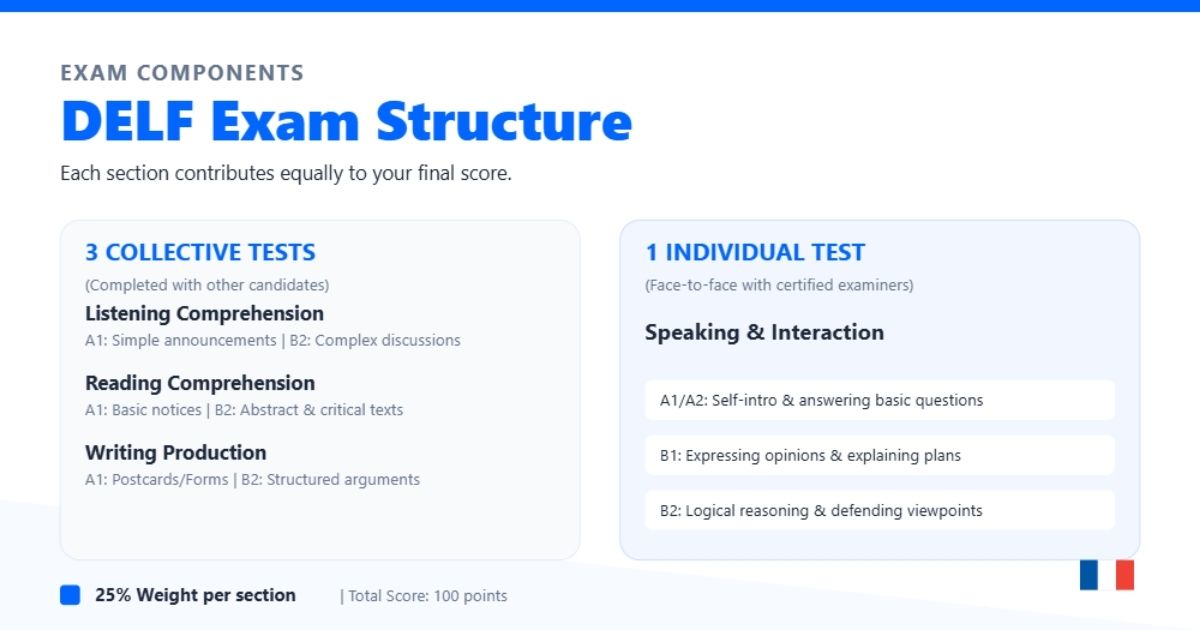
The DELF examination consists of:
- Three collective tests, completed with other candidates.
- One individual oral examination, conducted face-to-face with certified examiners.
The four components are:
| Exam Component | Skill Assessed |
| Listening | Understanding spoken French |
| Reading | Understanding written French |
| Writing | Producing written French |
| Speaking | Producing spoken French |
Each section contributes equally to the final score.
1. Listening Comprehension
The Listening section measures your ability to understand spoken French in a variety of everyday situations. Depending on the DELF level, you may hear:
- public announcements;
- short conversations;
- interviews;
- radio broadcasts;
- discussions;
- everyday dialogues.
As the level increases, both the complexity of the audio materials and the required listening skills become more demanding. For example:
- A1 candidates typically listen to short, simple recordings delivered slowly.
- B2 candidates are expected to understand longer discussions, interviews, and authentic spoken French with more complex ideas.
2. Reading Comprehension
The Reading section evaluates your ability to understand written French in practical contexts. Texts may include:
- advertisements;
- emails;
- notices;
- newspaper articles;
- informational texts;
- magazine excerpts.
Higher-level exams introduce longer texts with more abstract ideas and require candidates to identify arguments, opinions, and implicit meaning rather than simply locate factual information.
3. Writing
The Writing section assesses your ability to produce written French appropriate to your proficiency level. Tasks become progressively more complex. For example:
| DELF Level | Writing Focus | Typical Tasks |
| A1 | Basic written communication | Complete forms, write short messages, compose simple postcards. |
| A2 | Everyday communication | Write personal letters, invitations, and brief descriptions of familiar topics. |
| B1 | Connected writing | Describe experiences, express opinions, explain ideas, and justify choices in connected texts. |
| B2 | Advanced written communication | Develop structured arguments, analyze information, defend opinions, and write coherent texts suitable for academic or professional contexts. |
4. Speaking
The Speaking test evaluates your ability to communicate naturally in French. Unlike the written components, this is conducted individually with certified examiners. Typical speaking tasks include:
- introducing yourself;
- answering questions;
- participating in conversations;
- expressing opinions;
- discussing a topic;
- defending your viewpoint (B1–B2).
At higher levels, examiners assess not only grammatical accuracy but also fluency, interaction, coherence, and the ability to organize ideas effectively.
DELF Scoring System
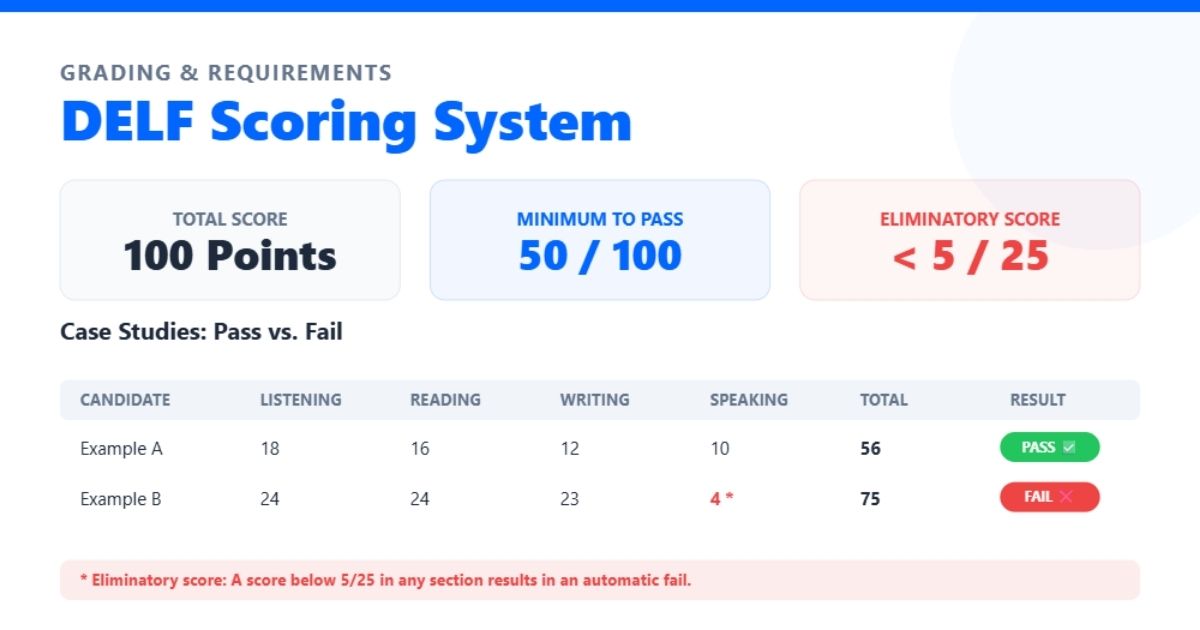
One of the most common questions candidates ask is: How is the DELF exam scored? The scoring system is straightforward. The DELF examination is marked out of 100 points. Each language skill is worth 25 points, giving all four sections equal weight.
| Skill | Maximum Score |
| Listening | 25 |
| Reading | 25 |
| Writing | 25 |
| Speaking | 25 |
| Total | 100 |
For example:
| Listening | Reading | Writing | Speaking | Result |
| 18 | 16 | 12 | 10 | ✅ Pass |
| 24 | 24 | 23 | 4 | ❌ Fail |
Although the second candidate scored 75/100 overall, they would not receive the diploma because a score below 5/25 in any single skill is considered eliminatory.
Conclusion
The DELF certificate is one of the most respected French language qualifications available today. If you’re ready to build your French skills with confidence, GuruLango offers interactive lessons, practical vocabulary, grammar exercises, and structured learning paths designed to help learners improve their French step by step. Start learning today and move closer to earning your DELF certificate with confidence.