






Is There a Word for “Yes” in Mandarin Chinese?
No. Unlike English, Mandarin Chinese does not have one universal word for “yes.” Instead of replying with a single word, native speakers usually answer by:
- repeating the verb from the question;
- repeating the adjective;
- or choosing an appropriate affirmative expression based on the context.

Why Doesn’t Mandarin Chinese Have One Universal Word for “Yes”?
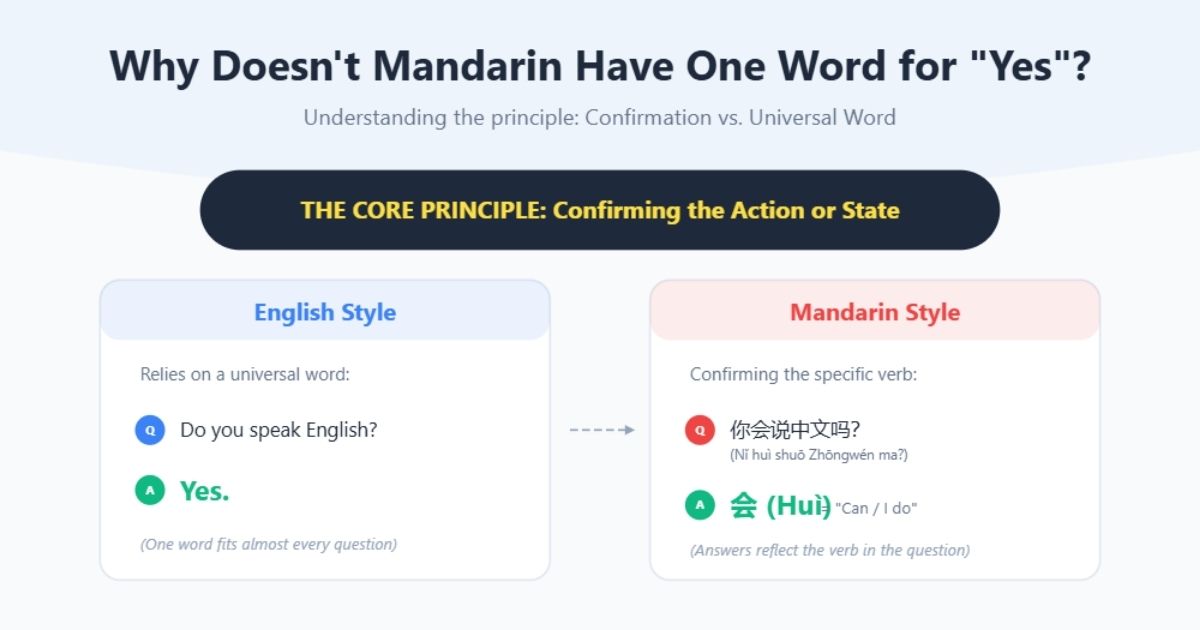
Understanding this principle will make learning Mandarin much easier. English relies heavily on yes and no to answer questions. For example:
- Do you speak English?
- Yes.
However, Mandarin Chinese focuses on confirming the action or state mentioned in the question rather than using a separate word. For example:
- 你会说中文吗? (Nǐ huì shuō Zhōngwén ma?)
- 会。(Huì.)
The Most Common Ways to Say Yes in Mandarin Chinese
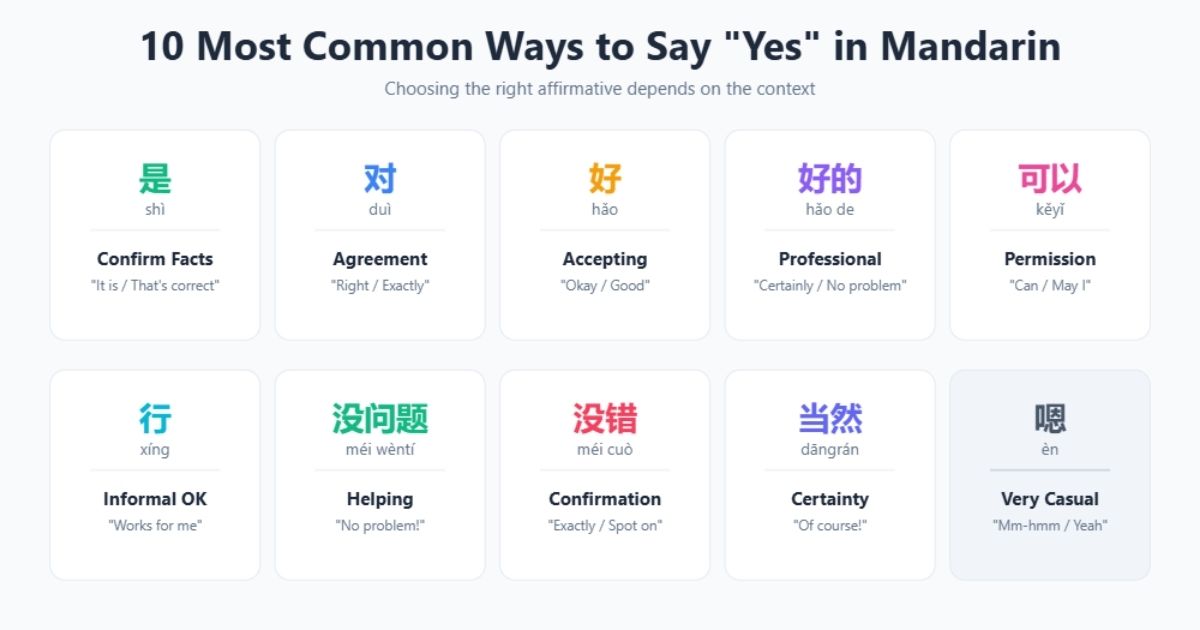
Now let’s look at the most common affirmative expressions you’ll hear in everyday Mandarin. Each expression has its own purpose, so choosing the right one depends on the situation.
1. 是 (shì)
Pinyin: shì
Meaning:
- Yes.
- That’s correct.
- It is.
When to use: Use 是 to confirm identity, facts, or statements involving the verb to be.
Example
A: 你是老师吗?(Nǐ shì lǎoshī ma?) Are you a teacher?
B: 是。(Shì.)Yes.
2. 对 (duì)
Pinyin: duì
Meaning
- That’s right.
- Correct.
- Exactly.
When to use: Use 对 when agreeing with information or confirming that something is correct.
Example
A: 今天星期五,对吗?(Is today Friday?)
B: 对。Correct.
3. 好 (hǎo)
Pinyin: hǎo
Meaning
- Okay.
- Sure.
- Sounds good.
When to use: Use 好 when accepting invitations, agreeing to suggestions, or responding positively to requests.
Example
A: 我们去吃饭吧。Let’s have dinner.
B: 好!Sounds good!
4. 好的 (hǎo de)
Pinyin: hǎo de
Meaning
- Certainly.
- Okay.
- No problem.
When to use: Compared with 好, 好的 sounds more polite and professional.
Example
- Customer: 请给我一杯咖啡。One coffee, please.
- Staff: 好的。Certainly.
5. 可以 (kěyǐ)
Pinyin: kěyǐ
Meaning
- Yes.
- Certainly.
- You may.
- Can.
When to use: Use 可以 when giving permission or confirming ability.
Example
A: 我可以坐这里吗?May I sit here?
B: 可以。Of course.
6. 行 (xíng)
Pinyin: xíng
Meaning
- Okay.
- That works.
- Fine.
When to use: This expression is very common in spoken Mandarin. It is slightly more casual than 可以.
Example
A: 明天见?See you tomorrow?
B: 行。Sounds good.
7. 没问题 (méi wèntí)
Pinyin: méi wèntí
Meaning
- No problem.
- Absolutely.
When to use: Perfect for agreeing to help someone.
Example
A: 你能帮我吗?Can you help me?
B: 没问题!No problem!
8. 没错 (méi cuò)
Pinyin: méi cuò
Meaning
- Exactly.
- That’s right.
When to use: Use it to strongly confirm that someone is correct.
Example
A: 北京是中国的首都。Beijing is the capital of China.
B: 没错!Exactly!
9. 当然 (dāngrán)
Pinyin: dāngrán
Meaning: Of course.
Example
A: 我可以进去吗?May I come in?
B: 当然。Of course.
10. 嗯 (èn)
Pinyin: èn
Meaning
- Mm-hmm.
- Yeah.
When to use: This is an informal spoken response. Native speakers use it constantly in everyday conversations.
Example: 嗯,好。Yeah, okay.
See also: 100+ Chinese Adverbs to Level Up Your Mandarin
How Native Speakers Say “Yes” in Real-Life Dialogues
Now that you’ve learned the most common ways to say yes in Mandarin Chinese, let’s see how these expressions are used in real conversations. Notice how native speakers choose different affirmative responses depending on the context rather than relying on a single word.
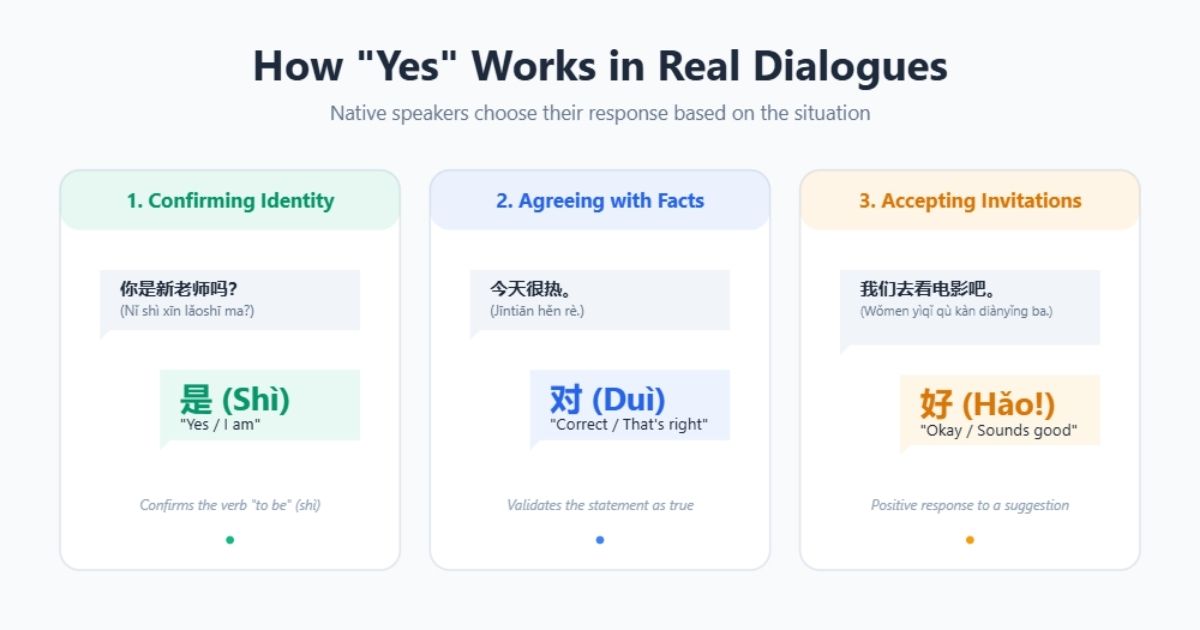
Dialogue 1: Meeting Someone for the First Time
A: 你是新老师吗?(Nǐ shì xīn lǎoshī ma?) Are you the new teacher?
B: 是。(Shì.) Yes.
Dialogue 2: Agreeing with Someone
A: 今天很热。(Jīntiān hěn rè.) It’s very hot today.
B: 对。(Duì.) That’s right.
Dialogue 3: Accepting an Invitation
A: 我们一起去看电影吧。(Wǒmen yìqǐ qù kàn diànyǐng ba.) Let’s watch a movie together.
B: 好!(Hǎo!) Sounds good!
Dialogue 4: Giving Permission
A: 我可以拍照吗?(Wǒ kěyǐ pāizhào ma?) May I take a photo?
B: 可以。(Kěyǐ.) Sure.
Dialogue 5: Casual Conversation Between Friends
A: 明天一起吃午饭吗?(Míngtiān yìqǐ chī wǔfàn ma?) Do you want to have lunch together tomorrow?
B: 行。(Xíng.) Sure.
Dialogue 6: Customer Service
Customer: 请给我一杯茶。(Qǐng gěi wǒ yì bēi chá.) One cup of tea, please.
Staff: 好的。(Hǎo de.) Certainly.
Dialogue 7: Offering Help
A: 你能帮我搬一下箱子吗?(Nǐ néng bāng wǒ bān yíxià xiāngzi ma?) Can you help me move this box?
B: 没问题!(Méi wèntí!) No problem!
Dialogue 8: Answering by Repeating the Verb
A: 你喜欢中国菜吗?(Nǐ xǐhuān Zhōngguó cài ma?) Do you like Chinese food?
B: 喜欢。(Xǐhuān.) Yes, I do.
Read more:
Common Mistakes When Saying “Yes” in Mandarin Chinese
Many beginners understand the vocabulary but still sound unnatural because they use the wrong expression in the wrong situation. Here are some of the most common mistakes to avoid.
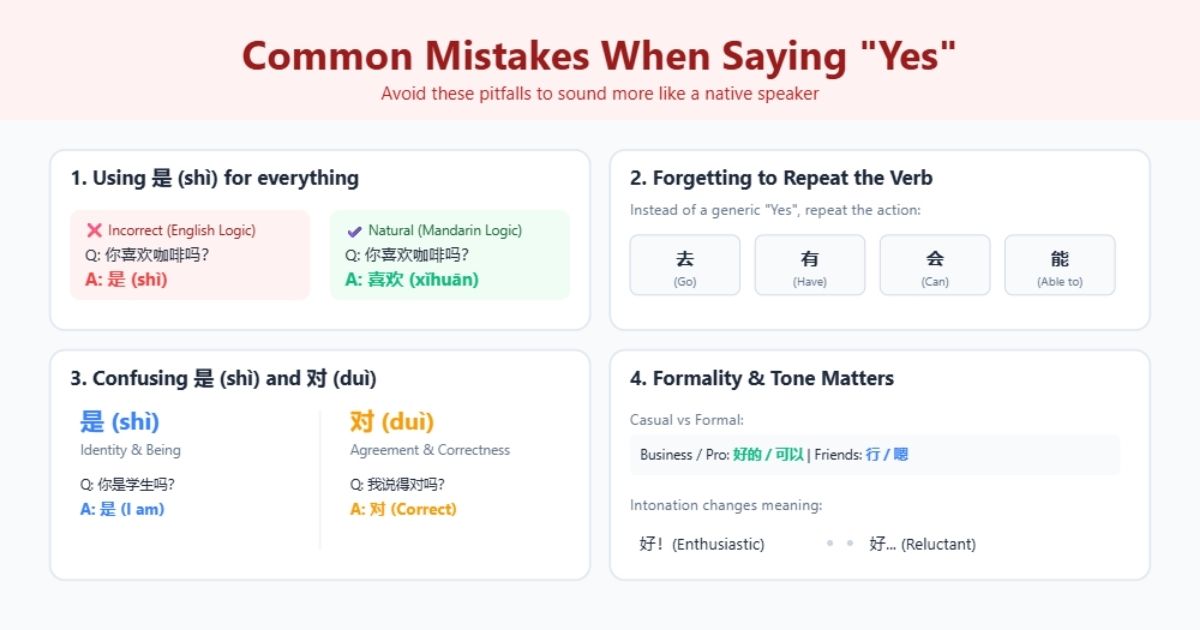
1. Using 是 (shì) for Every “Yes”
This is probably the most common mistake among English speakers.
| ❌ Incorrect | ✔ Natural |
| A: 你喜欢咖啡吗?
B: 是。 |
A: 你喜欢咖啡吗?
B: 喜欢。 |
| Remember that 是 is mainly used to confirm identity or statements involving the verb to be. | |
2. Forgetting to Repeat the Verb
Many learners translate directly from English. Instead of saying: Yes. Chinese speakers often answer:
- 去。
- 有。
- 会。
- 喜欢。
Repeating the verb makes your Chinese sound much more natural.
3. Confusing 对 and 是
Although both can be translated as “yes,” they serve different purposes.
| 是 (shì) | 对 (duì) |
| Confirms identity or facts | Confirms correctness or agreement |
|
Example: A: 你是学生吗? B: 是。 A: 我说得对吗? B: 对。 |
|
4. Using 行 (xíng) in Formal Situations
行 is common in casual conversations with friends or colleagues. However, in formal settings, 可以 or 好的 often sounds more polite. For example:
- Restaurant staff: ✔ 好的。
- Business meeting: ✔ 可以。
- Instead of: ✘ 行。
5. Ignoring Tone and Context
The same word can sound friendly, polite, hesitant, or even impatient depending on your tone of voice.
For example: 好!(enthusiastic)
vs.
好…… (reluctant)
Listening to native speakers is one of the best ways to develop a natural sense of these differences.
Conclusion
Learning how to say yes in Mandarin Chinese is about much more than memorizing a single word. Expressions like 是 (shì), 对 (duì), 好 (hǎo), 好的 (hǎo de), 可以 (kěyǐ), and 行 (xíng) all translate to some form of “yes,” but each has its own specific usage.
Want to go beyond learning how to say yes in Mandarin Chinese? GuruLango makes learning Chinese simple, engaging, and effective with interactive lessons designed for learners of all levels.