






I. How many words are required for HSK 2?
The HSK 2 vocabulary builds upon the vocabulary learned in HSK 1 vocabulary.
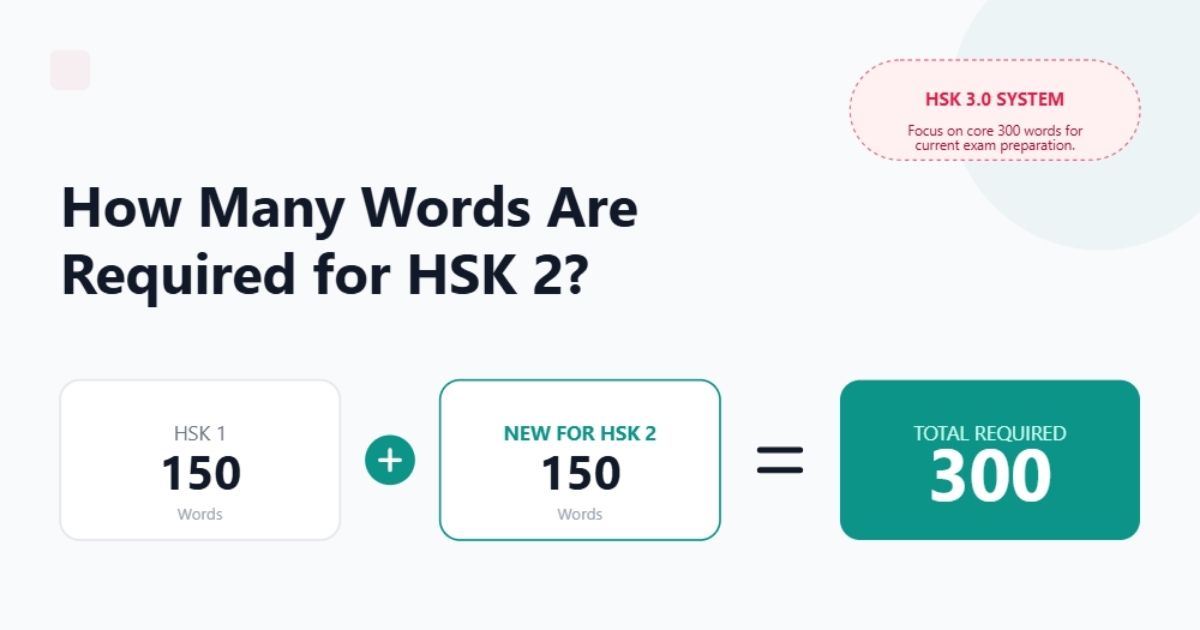
- HSK 2 Vocabulary Requirements (Old HSK System): Under the traditional HSK system, learners need to master approximately 300 vocabulary words in total, including the 150 words from HSK 1 and an additional 150 new words from HSK 2.
- HSK 2 Vocabulary Requirements (New HSK 3.0 System): Under the new Chinese Proficiency Standards (HSK 3.0), learners are expected to acquire a larger vocabulary base. However, many learners preparing for the current HSK 2 exam still focus on the official 300-word vocabulary list.
II. HSK 2 vocabulary by topic
Studying HSK 2 vocabulary by topic helps learners remember words faster and use them naturally in conversations.
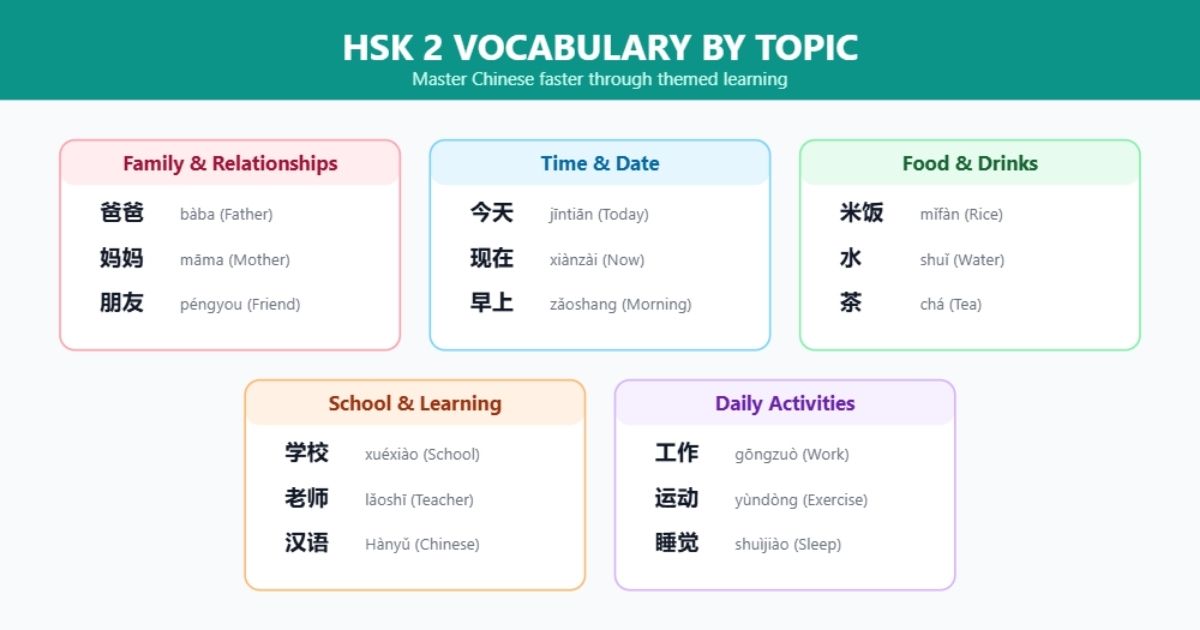
1. Family and Relationships
| Chinese | Pinyin | English |
| 爸爸 | bàba | father |
| 妈妈 | māma | mother |
| 哥哥 | gēge | older brother |
| 姐姐 | jiějie | older sister |
| 朋友 | péngyou | friend |
2. Time and Date
| Chinese | Pinyin | English |
| 今天 | jīntiān | today |
| 明天 | míngtiān | tomorrow |
| 现在 | xiànzài | now |
| 时候 | shíhou | time, moment |
| 早上 | zǎoshang | morning |
3. Food and Drinks
| Chinese | Pinyin | English |
| 米饭 | mǐfàn | rice |
| 水 | shuǐ | water |
| 苹果 | píngguǒ | apple |
| 茶 | chá | tea |
| 菜 | cài | dish, vegetable |
4. School and Learning
| Chinese | Pinyin | English |
| 学校 | xuéxiào | school |
| 学生 | xuésheng | student |
| 老师 | lǎoshī | teacher |
| 汉语 | Hànyǔ | Chinese language |
| 题 | tí | question |
5. Daily Activities
| Chinese | Pinyin | English |
| 工作 | gōngzuò | work |
| 学习 | xuéxí | study |
| 睡觉 | shuìjiào | sleep |
| 运动 | yùndòng | exercise |
| 看书 | kàn shū | read books |
III. Complete HSK 2 vocabulary list
The official HSK 2 vocabulary list contains essential words and expressions frequently used in daily conversations and exam questions. Learning these words systematically will help you communicate more confidently in Chinese and prepare effectively for the HSK 2 test. The following list includes Chinese characters, pinyin, and English translations for easy reference and review.
1. HSK 2 vocabulary according to the traditional 6-level HSK system
The traditional HSK system includes 150 new words introduced at HSK 2. Some commonly tested words include:
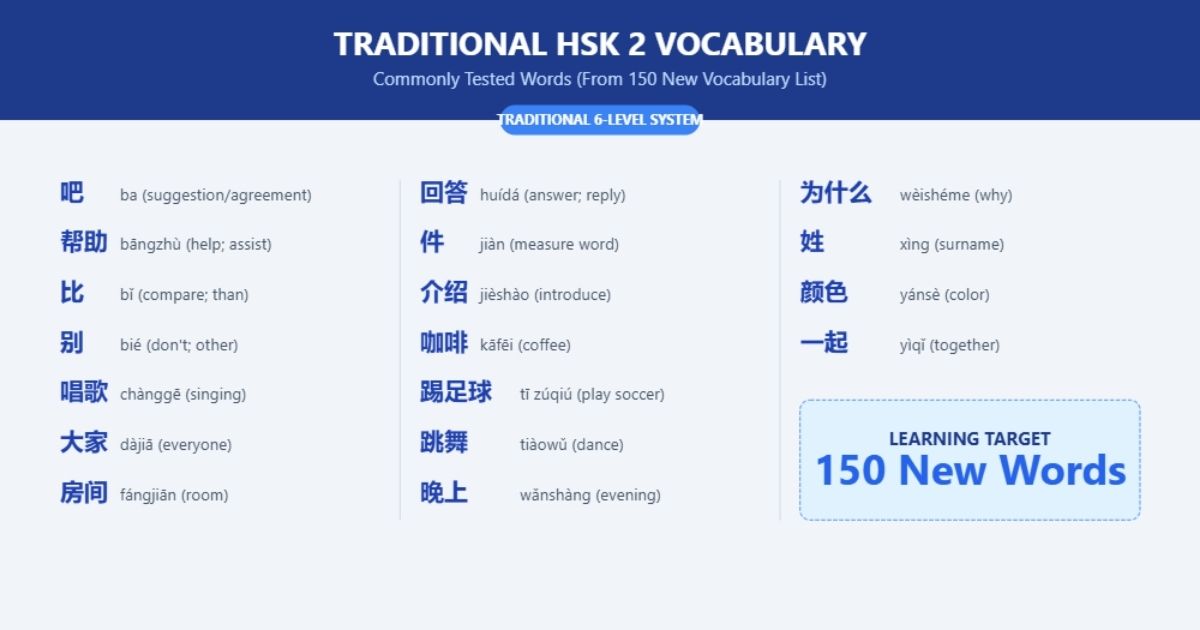
| Chinese | Pinyin | English |
| 吧 | ba | particle indicating suggestion, agreement, or assumption |
| 帮助 | bāngzhù | help; assist |
| 比 | bǐ | compare; than |
| 别 | bié | don’t; other |
| 唱歌 | chànggē | sing; singing |
| 次 | cì | time; occurrence; measure word for frequency |
| 大家 | dàjiā | everyone; everybody |
| 房间 | fángjiān | room |
| 回答 | huídá | answer; reply |
| 件 | jiàn | measure word for items, clothes, or matters |
| 介绍 | jièshào | introduce; introduction |
| 咖啡 | kāfēi | coffee |
| 踢足球 | tī zúqiú | play football; play soccer |
| 跳舞 | tiàowǔ | dance |
| 晚上 | wǎnshàng | evening; night |
| 为什么 | wèishéme | why |
| 姓 | xìng | surname; family name |
| 颜色 | yánsè | color |
| 一起 | yìqǐ | together; with each other |
2. HSK 2 vocabulary according to the new 9-level Chinese proficiency framework
The new Chinese proficiency framework expands vocabulary requirements and focuses on practical communication skills. Learners preparing for future HSK versions may encounter a broader range of words related to daily life, education, technology, and social interactions.
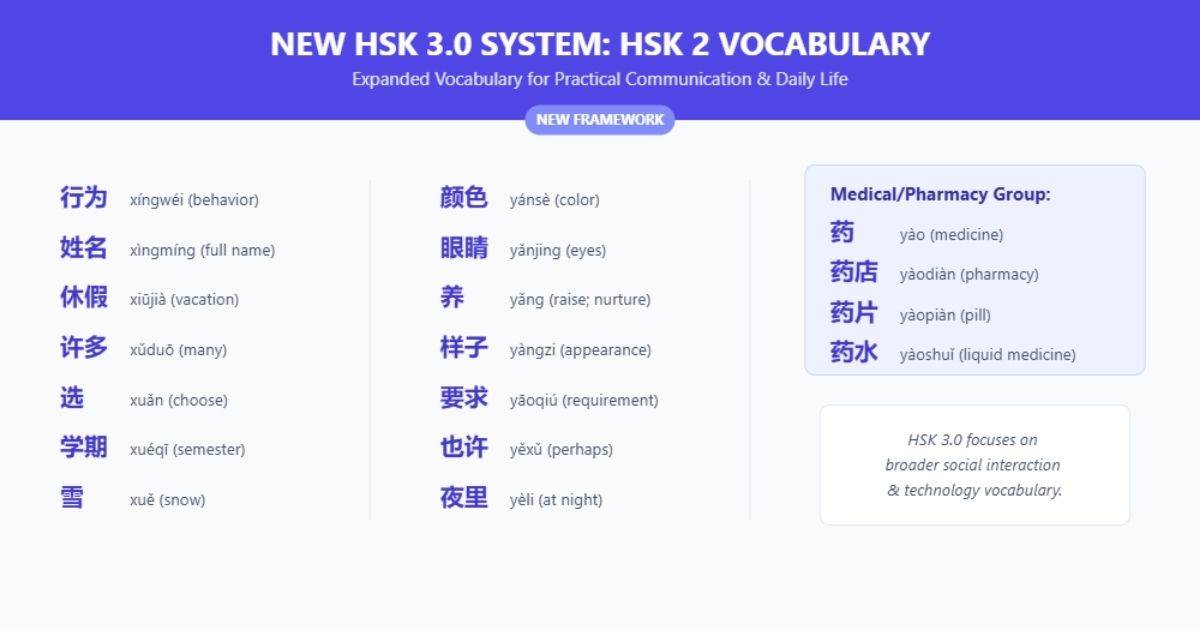
| Chinese | Pinyin | English |
| 行为 | xíngwéi | behavior; action |
| 姓 | xìng | surname; family name |
| 姓名 | xìngmíng | full name |
| 休假 | xiūjià | take leave; vacation |
| 许多 | xǔduō | many; a lot of |
| 选 | xuǎn | choose; select |
| 学期 | xuéqī | semester; school term |
| 雪 | xuě | snow |
| 颜色 | yánsè | color |
| 眼 | yǎn | eye |
| 眼睛 | yǎnjing | eye; eyes |
| 养 | yǎng | raise; keep; nurture |
| 样子 | yàngzi | appearance; look; shape |
| 要求 | yāoqiú | request; requirement; demand |
| 药 | yào | medicine |
| 药店 | yàodiàn | pharmacy; drugstore |
| 药片 | yàopiàn | pill; tablet |
| 药水 | yàoshuǐ | liquid medicine |
| 也许 | yěxǔ | perhaps; maybe |
| 夜 | yè | night |
| 夜里 | yèli | at night; during the night |
V. How to memorize HSK 2 vocabulary faster
Learning HSK 2 vocabulary is not just about memorizing word lists. Many learners can recognize hundreds of Chinese words during study sessions but struggle to recall them in conversations or exams. To build long-term retention, you need a combination of active recall, repeated exposure, and real-world practice. Here are some proven methods to learn and remember HSK 2 vocabulary more effectively.

1. Use flashcards for active recall
Flashcards remain one of the most effective tools for learning Chinese vocabulary because they force your brain to actively retrieve information rather than simply rereading it.
Instead of writing only the Chinese word and its meaning, create flashcards that include:
- Chinese characters
- Pinyin
- English definition
- Example sentence
- Audio pronunciation (if available)
For example:
- Front: 帮助
- Back: bāngzhù – to help; assistance
Example: 他帮助我学习汉语。(He helps me study Chinese.)
To maximize retention, review flashcards using the spaced repetition method. Words you find difficult should appear more frequently, while familiar words can be reviewed less often.
2. Learn through Chinese learning apps
One of the biggest challenges when studying HSK 2 vocabulary is maintaining consistency. Many learners spend hours memorizing words but forget them after a few days because they rarely encounter them again. Language learning apps solve this problem by combining vocabulary review, listening practice, reading exercises, and interactive quizzes in one place.
For example, learners using GuruLango can practice HSK vocabulary through structured lessons designed around real-life communication situations. Instead of memorizing isolated words, students encounter vocabulary in dialogues, exercises, and listening activities, which helps reinforce understanding and improve long-term retention.

Another advantage of learning through apps is accessibility. Whether you’re commuting, taking a break, or studying before bed, even 10–15 minutes of daily practice can significantly improve vocabulary retention over time.
3. Learn HSK 2 vocabulary through context
Many learners make the mistake of memorizing vocabulary lists without understanding how words are actually used. As a result, they recognize words during tests but struggle to use them naturally.
A better approach is to learn each new word within a sentence.
For example: 喜欢 (xǐhuan) – to like
Instead of memorizing only the meaning, learn: 我喜欢看电影。(I like watching movies.)
By seeing vocabulary in context, you learn:
- Sentence structure
- Grammar patterns
- Common collocations
- Natural word usage
This method is especially useful for HSK 2 because the exam frequently tests vocabulary through short dialogues and sentence completion tasks.
4. Follow a structured vocabulary learning plan
Many learners fail to remember HSK 2 vocabulary because they study randomly. A structured study plan helps ensure consistent progress and regular review.
A practical approach is:
- Learn 10–15 new words per day
- Review yesterday’s vocabulary before learning new words
- Take a weekly vocabulary quiz
- Spend one day each week on revision only
Using a structured learning platform such as GuruLango can make this process easier by organizing lessons according to proficiency level and providing systematic vocabulary review. This allows learners to focus on steady improvement rather than deciding what to study next.
See also:
- How to Learn Chinese with Movies: A Comprehensive Guide
- Unlock Mandarin Fluency: How to Learn Chinese Fast and Effectively
Conclusion
Mastering HSK 2 vocabulary is a crucial milestone for beginner Chinese learners. By studying vocabulary by topic, practicing regularly, and using effective memorization techniques, you can confidently prepare for the exam and improve your communication skills. For a more structured learning experience, platforms like GuruLango can help you build vocabulary, practice pronunciation, and stay consistent throughout your HSK preparation journey.