






If you are learning Korean, understanding batchim Korean is one of the most important steps to improving your pronunciation. In this guide, Gurulango will explain what Korean batchim is, how single and double batchim work, and how to pronounce them naturally with easy examples for beginners.
I. What Is Batchim?
In Korean, batchim (받침) refers to the final consonant sound at the bottom of a Korean syllable block. Batchim plays an important role in Korean pronunciation because it affects how words sound in daily conversations. For example:한 (han);국 (guk);밥 (bap). The final consonants: ㄴ;ㄱ;ㅂ are called batchim.
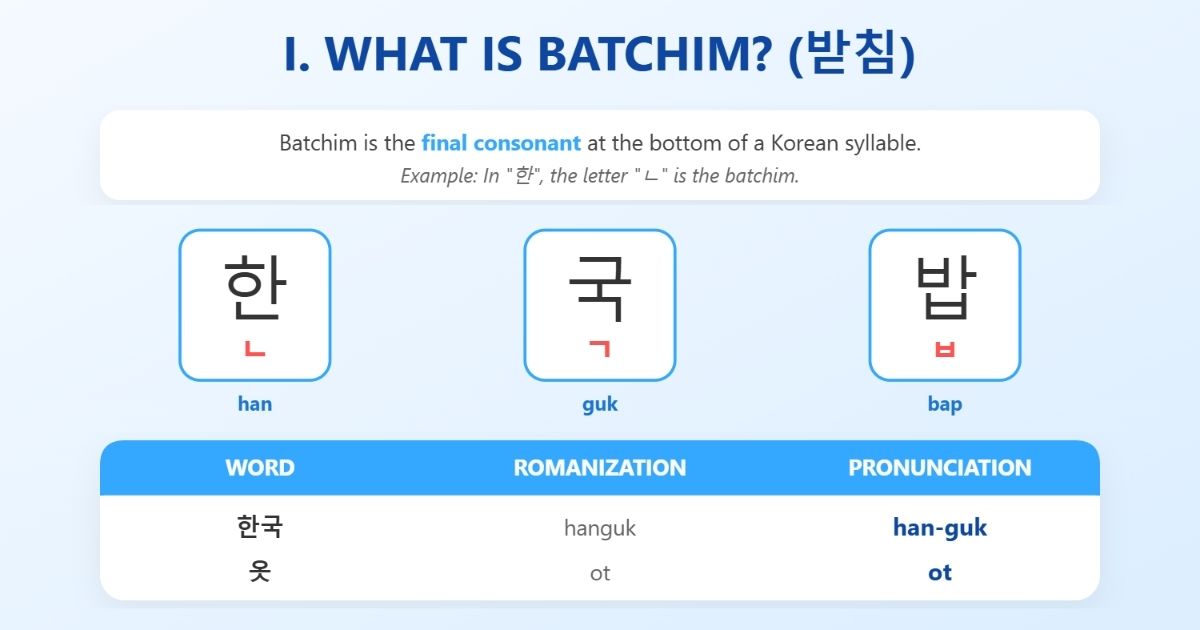
In Korean, not all consonants are pronounced the same way when they appear as batchim. Some sounds become softer or change depending on the next syllable. For example:
| Word | Romanization | Pronunciation |
| 한국 | hanguk | han-guk |
| 밥 | bap | bap |
| 옷 | ot | ot |
This is why learning batchim rules is essential for Korean beginners.
See also: How to Learn Korean: Expert Guide & Proven Methods
II. Single Batchim in Korean
Single batchim refers to syllables that end with one final consonant.
1. Type 1 Batchim: ㄴ, ㄹ, ㅁ, ㅇ
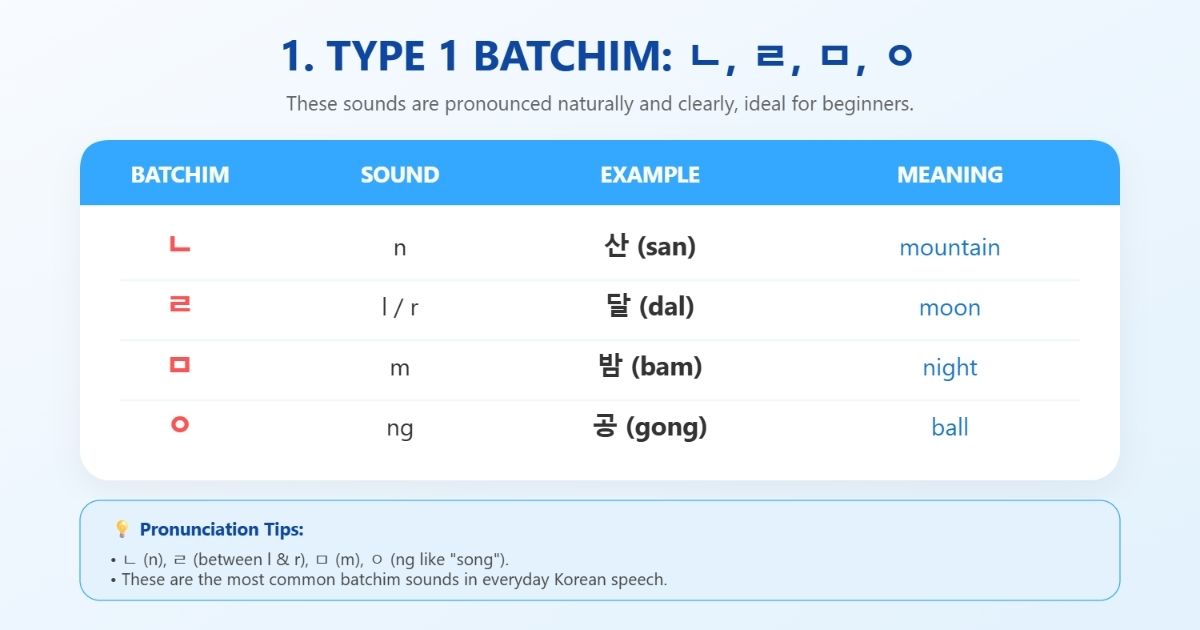
These batchim sounds are usually easier for beginners because they are pronounced naturally and clearly.
| Batchim | Sound | Example | Meaning |
| ㄴ | n | 산 (san) | mountain |
| ㄹ | l / r | 달 (dal) | moon |
| ㅁ | m | 밤 (bam) | night |
| ㅇ | ng | 공 (gong) | ball |
Pronunciation Tips:
- ㄴ sounds similar to “n”
- ㄹ sounds between “l” and “r”
- ㅁ sounds like “m”
- ㅇ sounds like “ng” in “song”
These are some of the most common Korean batchim sounds in everyday speech.
2. Type 2 Batchim: ㄷ, ㅌ, ㅅ, ㅆ, ㅈ, ㅊ
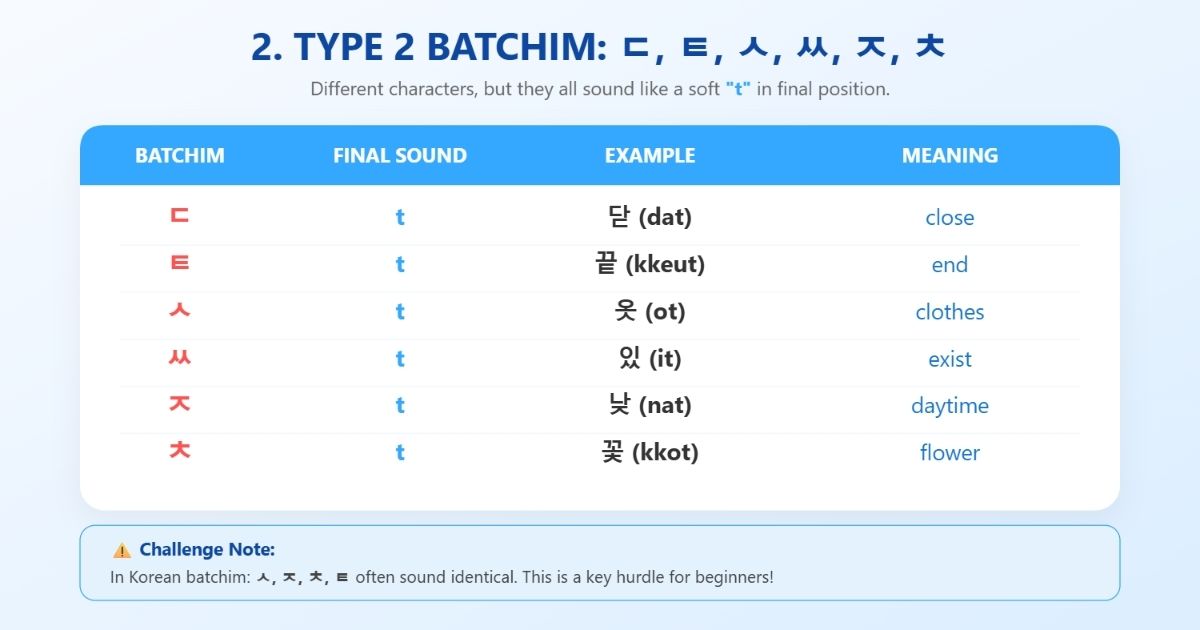
Although these consonants look different, they are usually pronounced as a soft “t” sound in final position.
| Batchim | Final Sound | Example | Meaning |
| ㄷ | t | 닫 (dat) | close |
| ㅌ | t | 끝 (kkeut) | end |
| ㅅ | t | 옷 (ot) | clothes |
| ㅆ | t | 있 (it) | exist |
| ㅈ | t | 낮 (nat) | daytime |
| ㅊ | t | 꽃 (kkot) | flower |
In Korean batchim pronunciation: ㅅ;ㅈ;ㅊ;ㅌoften sound nearly identical at the end of a syllable. This is one of the most challenging parts for Korean learners.
3. Type 3 Batchim: ㄱ, ㄲ, ㅋ, ㅂ, ㅍ
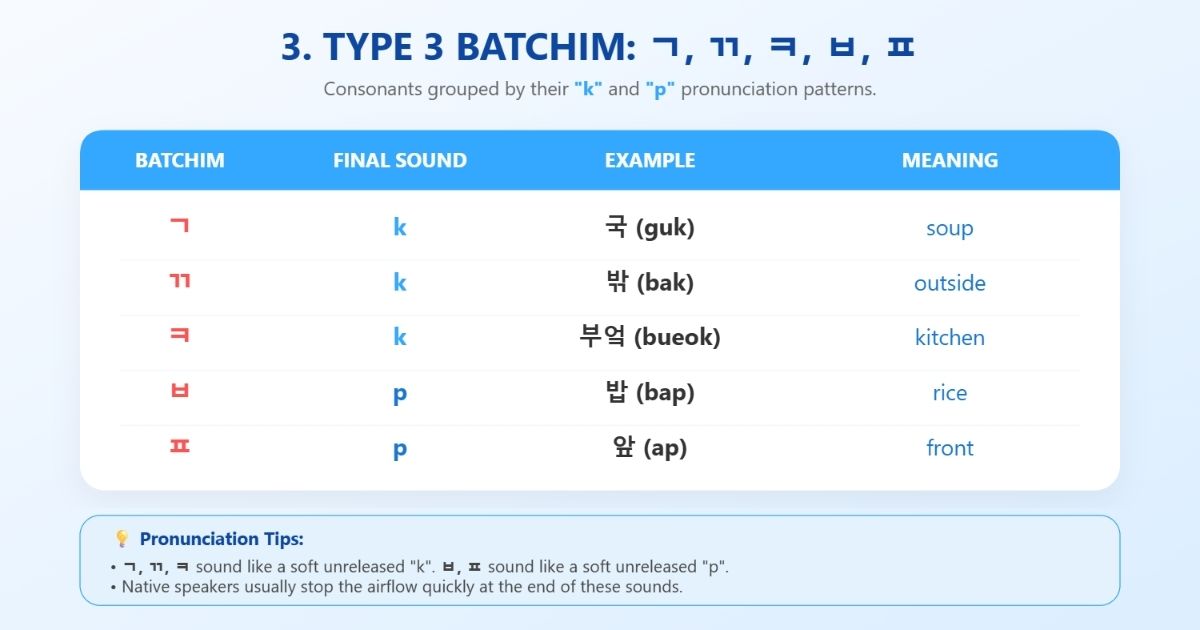
These consonants also share similar pronunciation patterns when used as batchim.
| Batchim | Final Sound | Example | Meaning |
| ㄱ | k | 국 (guk) | soup |
| ㄲ | k | 밖 (bak) | outside |
| ㅋ | k | 부엌 (bueok) | kitchen |
| ㅂ | p | 밥 (bap) | rice |
| ㅍ | p | 앞 (ap) | front |
Pronunciation Tips:
- ㄱ, ㄲ, ㅋ sound like a soft unreleased “k”
- ㅂ and ㅍ sound like a soft unreleased “p”
Native Korean speakers usually stop the airflow quickly at the end of these sounds.
Read more: Learn Korean for Beginners: Your Roadmap to Korean Fluency
III. Double Batchim in Korean
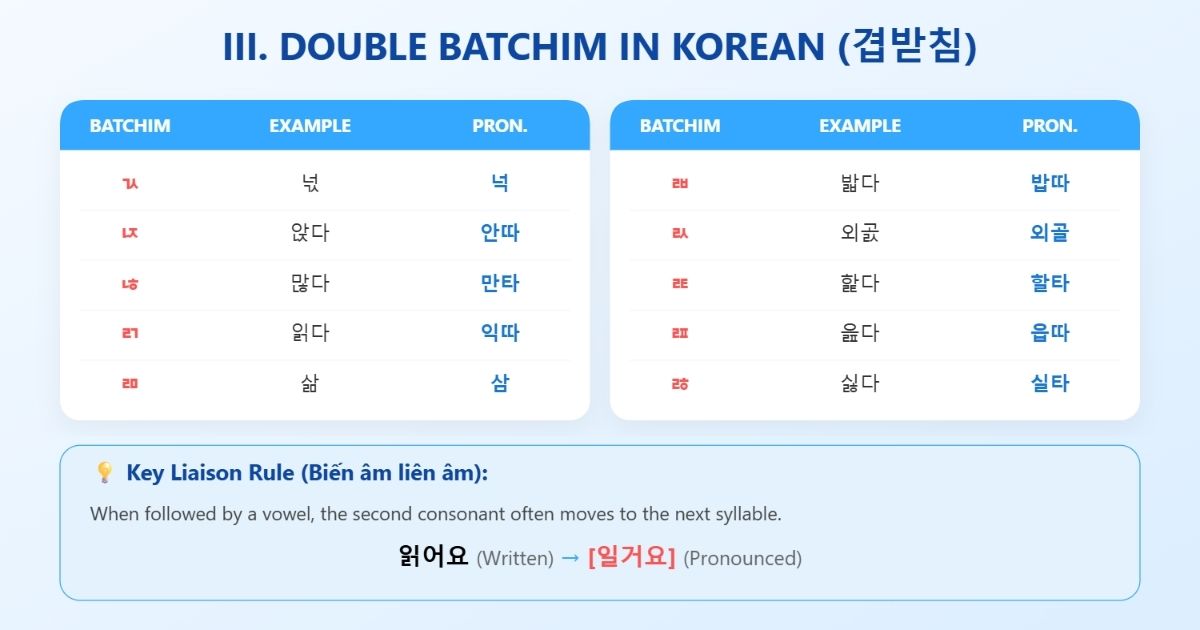
Double batchim (겹받침) happens when two consonants appear together at the bottom of a syllable. Common double batchim examples
| Double Batchim | Example | Pronunciation |
| ㄳ | 넋 | 넉 |
| ㄵ | 앉다 | 안따 |
| ㄶ | 많다 | 만타 |
| ㄺ | 읽다 | 익따 |
| ㄻ | 삶 | 삼 |
| ㄼ | 밟다 | 밥따 |
| ㄽ | 외곬 | 외골 |
| ㄾ | 핥다 | 할타 |
| ㄿ | 읊다 | 읍따 |
| ㅀ | 싫다 | 실타 |
How to pronounce Korean double batchim. In many cases:
- only one consonant is pronounced
- the pronunciation changes depending on the next syllable
- liaison rules may occur when followed by a vowel
For example: 읽어요. Although written: 읽어요, it is pronounced: 일거요. This pronunciation change is very common in spoken Korean.
See also: A Guide On How To Count Numbers In Korean From 1 To 99
Conclusion
Learning batchim is essential for anyone studying Korean pronunciation. Once you understand how Korean batchim works, you will read Hangul more confidently, improve your listening skills, and sound more natural in conversations.
With Gurulango, you can learn Korean vocabulary, pronunciation, and batchim rules step by step through beginner-friendly lessons and practical daily exercises. Start learning Korean smarter and faster with Gurulango today!