






I. What Does “Come” Mean? What is Phrasal Verbs With Come?
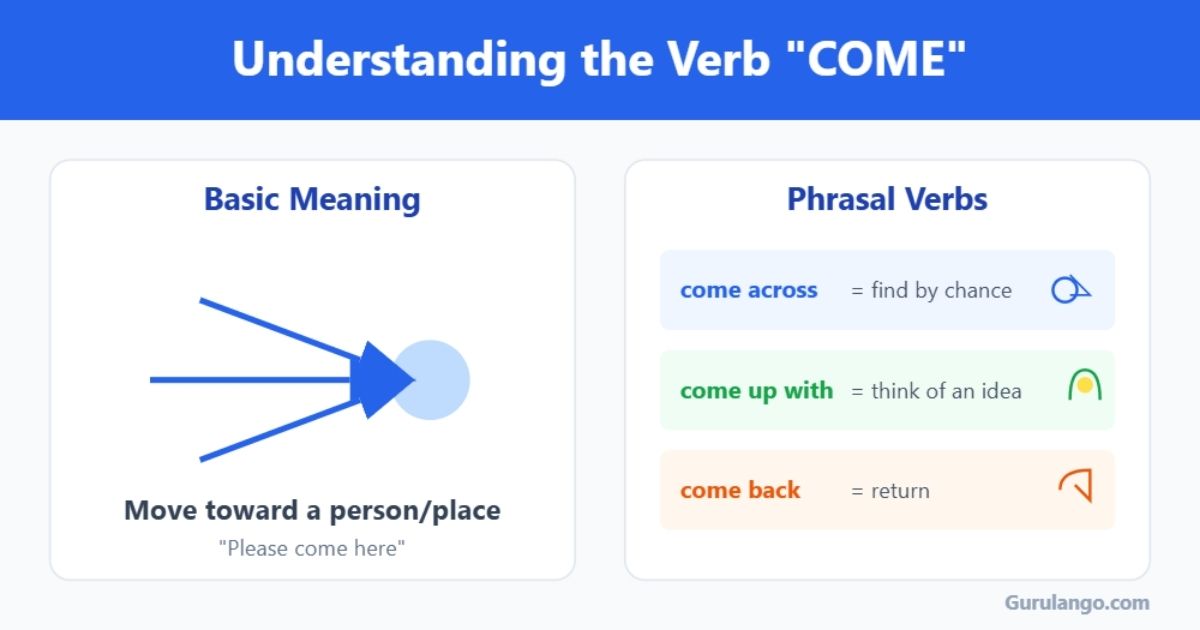
As a main verb, come generally means to move toward a person, place, or situation, usually toward the speaker or a particular destination.
Examples:
- Please come here.
- She came home late.
- My parents are coming tomorrow.
The verb come has several meanings depending on the context, but its meaning changes even more when it is combined with a particle such as back, across, over, up, down, or through.
These combinations are called phrasal verbs.
For example:
- come + back → come back = return
- come + across → come across = find by chance
- come + up with → come up with = think of an idea
Because these meanings cannot always be guessed from the individual words, learning them as complete phrases is essential.
30+ Common Phrasal Verbs with Come
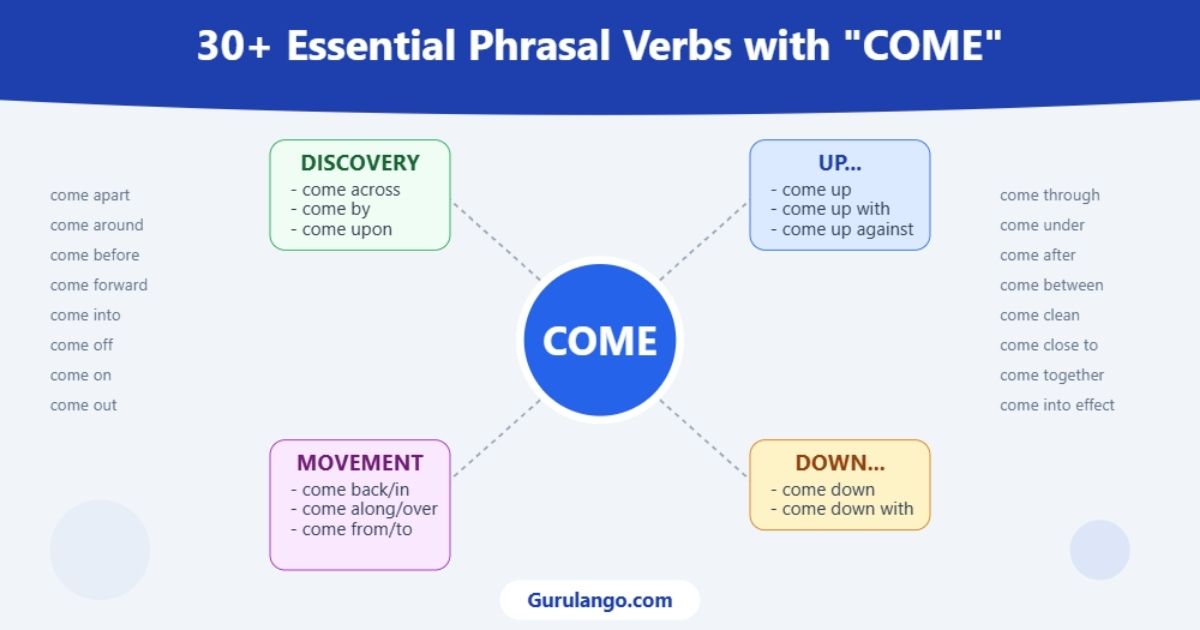
Here is a list of common phrasal verbs with come that English learners should know.
| No. | Phrasal Verb | Meaning | Example |
| 1 | come across | find something by chance | I came across an old photo. |
| 2 | come along | accompany someone; make progress | Would you like to come along? |
| 3 | come apart | separate into pieces | The old book is coming apart. |
| 4 | come around | visit; regain consciousness; change one’s opinion | He finally came around to our idea. |
| 5 | come back | return | She came back from work at six. |
| 6 | come before | have greater importance or priority than | Safety should come before speed. |
| 7 | come by | obtain or get | How did you come by this information? |
| 8 | come down | fall; decrease | Prices have come down recently. |
| 9 | come down with | become ill | I came down with a cold. |
| 10 | come forward | offer help or information | Several witnesses came forward. |
| 11 | come from | originate from | This cheese comes from France. |
| 12 | come in | enter | Please come in and take a seat. |
| 13 | come into | inherit or receive | She came into a large inheritance. |
| 14 | come off | succeed; become detached | The sticker came off easily. |
| 15 | come on | start; hurry up; encourage | Come on! We’re going to be late. |
| 16 | come out | be published; become known; appear | Her new book came out last month. |
| 17 | come over | visit someone’s home | Why don’t you come over tonight? |
| 18 | come through | survive; successfully deal with a difficult situation | She came through the operation successfully. |
| 19 | come to | regain consciousness; reach a total | The bill came to $80. |
| 20 | come under | be classified under; be subjected to | The project comes under the education department. |
| 21 | come up | appear; be mentioned; arise | An interesting question came up. |
| 22 | come up against | face a problem or difficulty | We came up against several challenges. |
| 23 | come up with | think of or produce an idea | She came up with a great solution. |
| 24 | come upon | find unexpectedly | We came upon a small village. |
| 25 | come after | follow or chase | The police came after the suspect. |
| 26 | come between | cause disagreement between people | Money came between the two friends. |
| 27 | come clean | tell the truth; admit something | He finally came clean about the mistake. |
| 28 | come close to | almost do something | She came close to winning the competition. |
| 29 | come first | have the highest priority | Your safety should come first. |
| 30 | come together | unite; gather | The team came together to solve the problem. |
| 31 | come under attack | be attacked or strongly criticized | The company came under attack for its decision. |
| 32 | come into effect | begin to operate or be applied | The new rules will come into effect next month. |
See also:
Common Confused Phrasal Verbs with Come
Some phrasal verbs with come have similar meanings or structures, making them easy to confuse.
Come Up vs. Come Up With
These two expressions are easy to confuse because they look very similar.
- Come up
Means that something appears, happens, arises, or is mentioned.
A problem came up during the meeting.
Here, come up means that the problem arose or appeared.
- Come up with
Means to think of, create, or produce an idea, answer, or solution.
We came up with a solution to the problem.
- Compare
| Expression | Meaning | Example |
| come up | appear, arise, or be mentioned | A problem came up. |
| come up with | think of or create something | We came up with a solution. |
A useful way to remember the difference is:
Something comes up → you come up with an idea/solution.
Come Across vs. Come Upon
Both come across and come upon can mean find something unexpectedly.
- Come across
More common in everyday English:
I came across an old friend at the supermarket.
I came across an interesting website yesterday.
- Come upon
More formal or literary:
We came upon a beautiful village while hiking.
In everyday conversation, come across is generally the more natural choice.
Come In vs. Come Over
These two expressions are also commonly confused.
- Come in
Means enter a room, building, or enclosed space.
Please come in and sit down.
- Come over
Means visit someone’s home or the place where they are.
Why don’t you come over this evening?
- Compare:
Come in. → Enter the room.
Come over. → Visit me at my home/place.
Come Back vs. Come Again
These expressions have different uses.
- Come back
Means return.
She came back home at 9 p.m.
- Come again
Usually means return another time or, in conversation, repeat what you said.
Please come again soon.
Come again? I didn’t hear you.
How to Learn Phrasal Verbs with Come Effectively
Memorizing a long list of phrasal verbs is not always the best way to learn them. Instead, try these strategies.
1. Learn the Whole Expression
Don’t memorize only: come + up
Learn:
come up = appear, arise, or be mentioned
Then learn it in a sentence.
Something unexpected came up at work.
This helps you remember how the expression is actually used.
2. Learn Phrasal Verbs in Context
A single example sentence can make the meaning much easier to remember.
For example:
I came across an old diary while cleaning my room.
From this sentence, you can understand that come across describes finding something unexpectedly.
3. Group Similar Phrasal Verbs Together
You can organize phrasal verbs by meaning:
Returning:
- come back
- come around
Finding something:
- come across
- come upon
Ideas and solutions:
- come up with
Illness:
- come down with
Visiting:
- come over
- come around
Learning them in groups can make them easier to compare and remember.
4. Pay Attention to the Particle
The particle can significantly change the meaning of come.
For example:
- come back → return
- come in → enter
- come over → visit
- come up → appear or arise
- come down → fall or decrease
- come through → survive or succeed
Therefore, don’t assume that the meaning of one come phrasal verb will tell you the meaning of another.
Conclusion
Mastering phrasal verbs with come will make your English sound much more natural and fluent. Want to expand your vocabulary beyond phrasal verbs with come? GuruLango offers thousands of interactive English lessons covering phrasal verbs, idioms, grammar, pronunciation, and real-life conversations. With personalized learning paths, quizzes, and spaced repetition, GuruLango helps learners build lasting English skills anytime, anywhere.