






What is Pinyin?
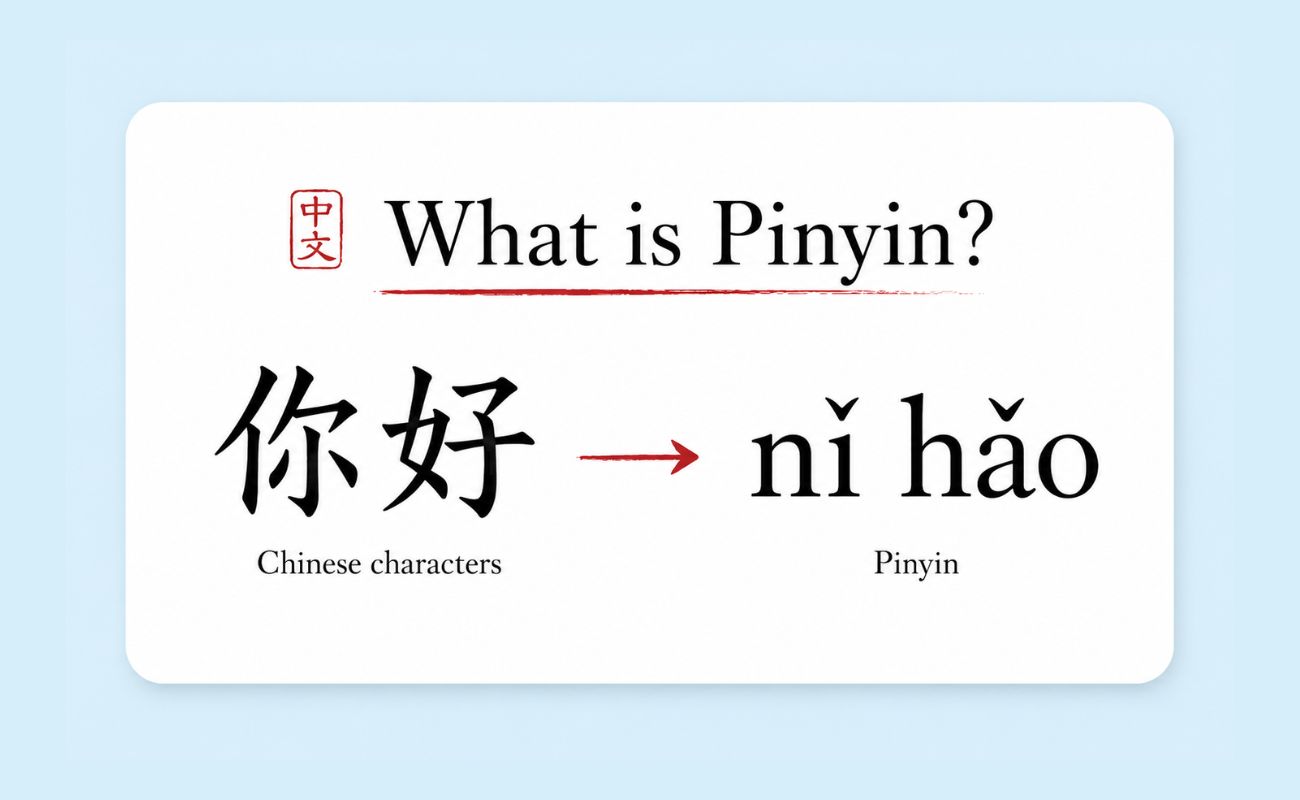
Pinyin is the official romanization system for Standard Mandarin Chinese. It uses familiar Latin letters to show how Chinese words are pronounced.
For example, 你好 is written as nǐ hǎo in Pinyin. The difference between 你好 and nǐ hǎo gives a simple answer to the question “what is Pinyin” since one shows the Chinese phrase, and the other shows how that phrase sounds.
However, Pinyin is not a replacement for Chinese characters. Think of it as a pronunciation guide: it helps you hear, say, and type Mandarin more easily before you become comfortable reading characters directly.
How does Pinyin work in Mandarin Chinese?
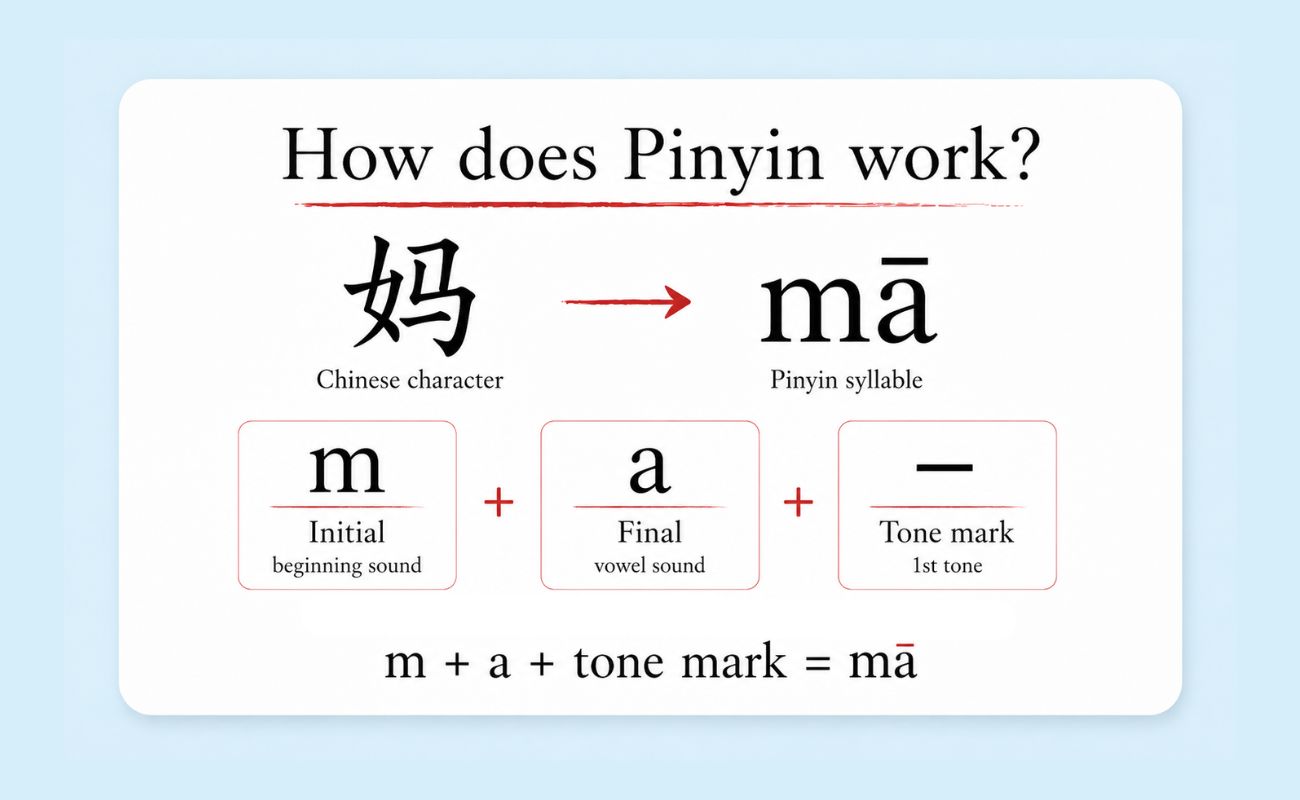
Pinyin works by turning the sound of a Mandarin syllable into Latin letters, plus a tone mark. In most cases, a Pinyin syllable has three parts:
- An initial: the beginning sound, usually a consonant
- A final: the vowel sound or the rest of the syllable
- A tone mark: the mark that shows the pitch pattern
Take mā as an example. The letter “m“ is the initial, “a” is the final, and the line above “ā” tells you it uses the first tone. Together, they show how to pronounce the Chinese character 妈, meaning “mother.”
Pinyin Initials and Finals
Every Mandarin syllable is built from sounds. In Pinyin, these sounds are usually divided into initials and finals.
The initial is the sound at the beginning of a syllable. For example, in “nǐ”, the initial is “n”. In hǎo, the initial is “h”. Some Mandarin syllables do not have a consonant initial, such as “ài”, meaning “love.”
The final is the rest of the syllable. It can be a simple vowel, a vowel combination, or a vowel plus a nasal ending. For example:
- nǐ = n + i
- hǎo = h + ao
- zhōng = zh + ong
Pinyin letters do not always sound exactly like English letters. For instance, q in Pinyin is not pronounced like the English “q,” and “x” is not the same as the English “x.” This is why learning Pinyin as its own pronunciation system is so important.
Read more: How to Improve Chinese Pronunciation
Pinyin Tone Marks
Mandarin is a tonal language, so the tone can change the meaning of a word. Pinyin shows tones by placing marks above vowels.
For example:
- mā = first tone, high and flat (mother)
- má = second tone, rising (hemp or numb)
- mǎ = third tone, falling then rising (horse)
- mà = fourth tone, sharp and falling (to scold)
There is also a neutral tone, which is light and short, and it usually has no tone mark.
Why is Pinyin important for learning Chinese?
Most learners first ask, “what is Pinyin?”. But the better question is “why is it so important for learning Chinese”. Let’s look at the key reasons.

- It helps you pronounce words more accurately: Mandarin sounds are not always obvious from Chinese characters. Pinyin gives each syllable a readable form, so you know how a word should sound before you memorize the character.
- It makes Chinese less intimidating for beginners: Chinese characters can look complex when you first start learning. Pinyin gives you a friendly entry point, allowing you to read and say basic words before memorizing many characters.
- It trains your ear for real Mandarin: Pinyin helps you notice the small sound differences between initials, finals, and tones. This makes listening and speaking practice much more focused.
- It helps you type Chinese: On most phones and computers, you type the Pinyin pronunciation first, then choose the correct Chinese character.
Pinyin vs Chinese characters: What is the difference?
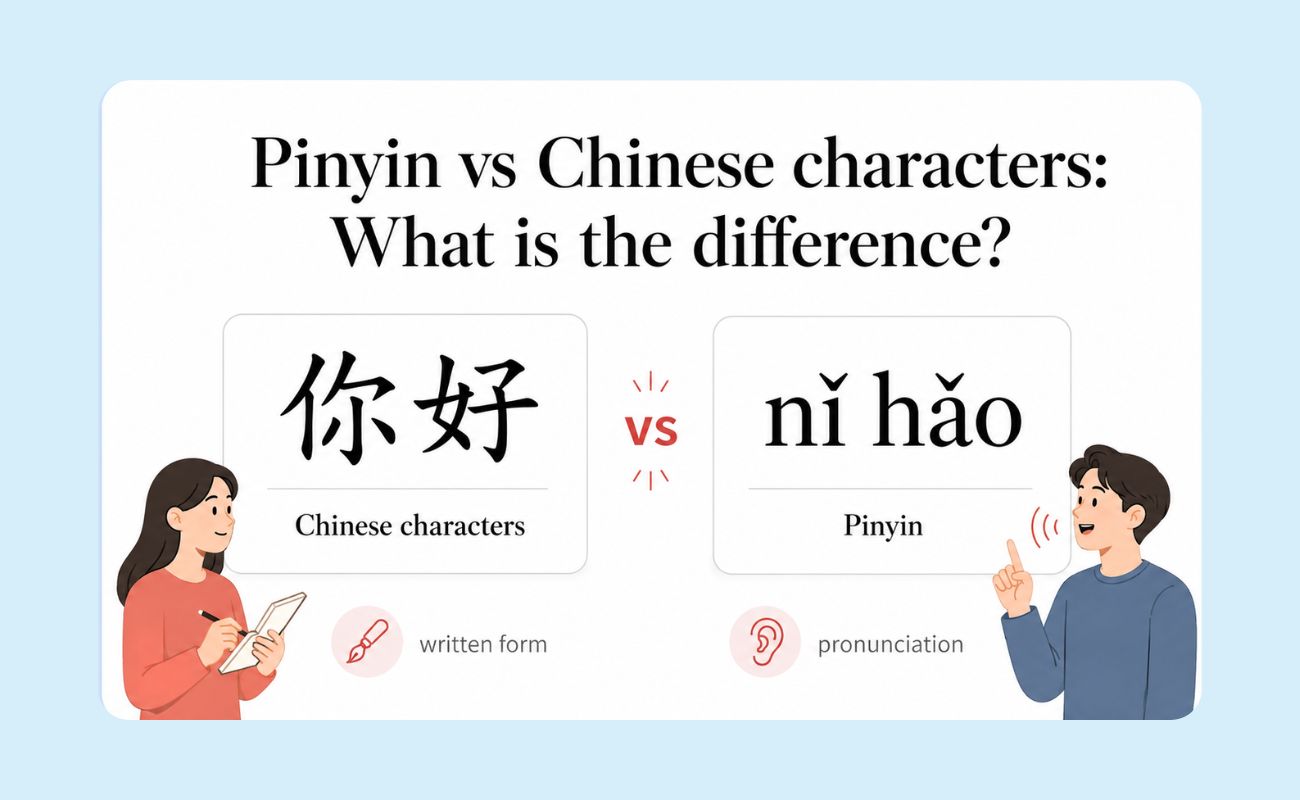
To understand what is Pinyin clearly, you also need to know how it works alongside Chinese characters.
| Pinyin | Chinese characters |
| Shows how a word is pronounced | Shows the meaning and written form of the word |
| Uses Latin letters and tone marks | Uses Chinese characters |
| Helps learners read, speak, and type Chinese | Helps readers understand written Chinese |
| Easier for beginners to start with | Takes more time to recognize and memorize |
| Mainly a pronunciation tool | The actual writing system used in Chinese |
For example, nǐ hǎo tells you how to say the phrase, while 你好 is how the phrase is written in Chinese. Both refer to the same greeting, but they are not interchangeable.
How to Read and Write Pinyin Correctly
Pinyin may look familiar because it uses Latin letters, but it does not always follow English pronunciation rules.
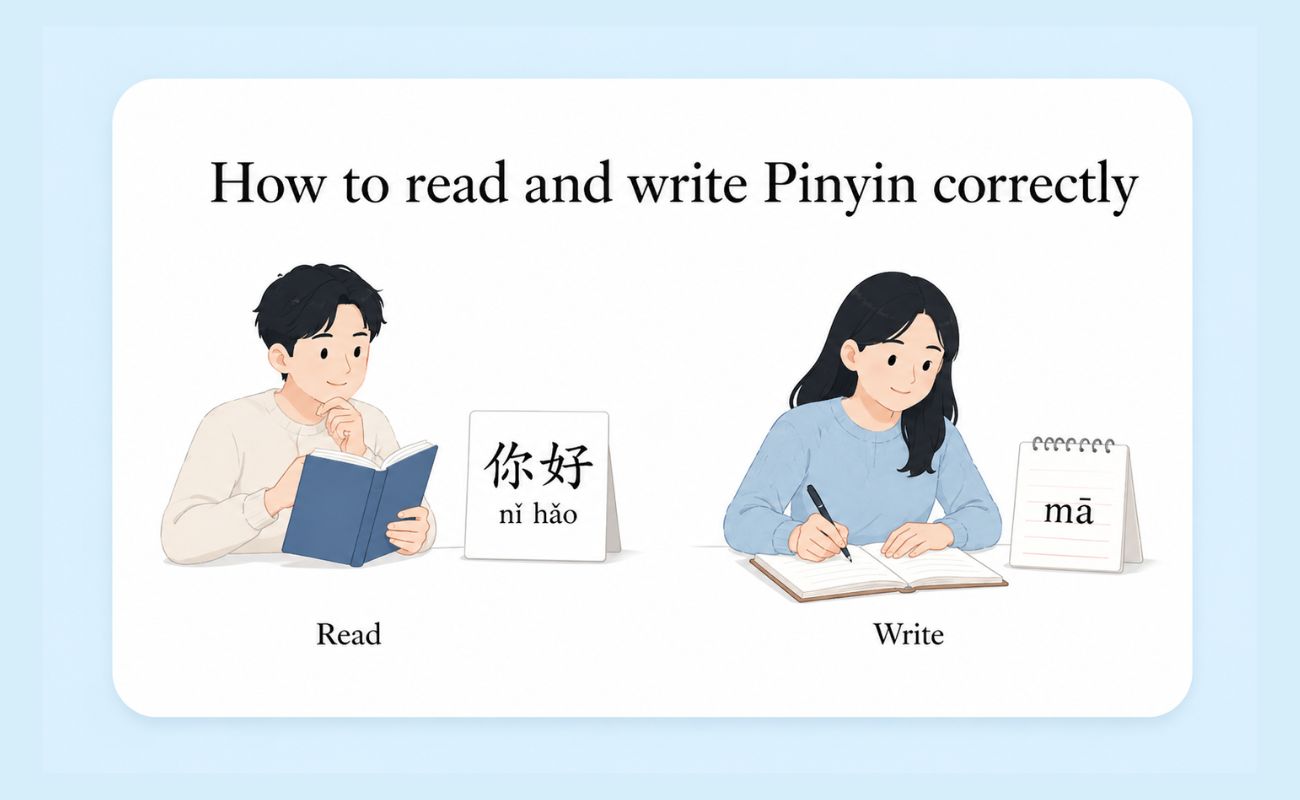
How to read Pinyin
Start by reading each syllable in three small parts: the initial, the final, and the tone.
For example, zhōng can be broken down into zh + ong + first tone. This makes long-looking words much easier to pronounce.
Some Pinyin letters are easy to misread if you follow English spelling habits.
For example, “q” is closer to a light “ch” sound, “x” sounds like a soft “sh” with the tongue higher and farther forward, while zh, ch, and sh are pronounced with the tongue slightly curled back. The vowel “ü” is also different: it is like saying “ee” while rounding your lips. These sounds are difficult to learn from letters alone, so it is better to read each syllable with native audio and repeat it aloud.
How to write Pinyin
To write Pinyin, start with the sound of the Chinese word, then write the syllable in this order:
- Initial: the beginning sound, such as n, h, or zh
- Final: the vowel or ending sound, such as i, ao, or ong
- Tone mark: the mark that shows the tone, such as ā, á, ǎ, or à
For example, 中文 is written as Zhōngwén: zh + ong becomes zhōng, and w + en becomes wén.
Common mistakes when learning Pinyin
By now, you have a clear answer to the question “What is Pinyin?”, but knowing the system is not the same as using it well. These common mistakes can make Mandarin pronunciation harder than it needs to be.
- Reading Pinyin like English: Pinyin uses familiar letters, but sounds like q, x, zh, ch, sh, and ü follow Mandarin pronunciation rules. Do not guess them from English spelling.
- Treating tones as optional: Tone marks are part of the word. A different tone can change the meaning completely, so learning ma without knowing whether it is mā, má, mǎ, or mà leaves the word unfinished.
- Practicing without native audio: Pinyin shows how a word is pronounced, but audio shows how it actually sounds in real speech. Listening and repeating are essential for building natural pronunciation.
- Learning Pinyin separately from characters: Pinyin helps with sound, while Chinese characters carry meaning. Learning them together makes each word easier to read, say, and remember.
- Memorizing isolated words: A word is easier to remember when you see it in context. Instead of learning Pinyin as random spelling, connect each word with its character, meaning, audio, and example usage.
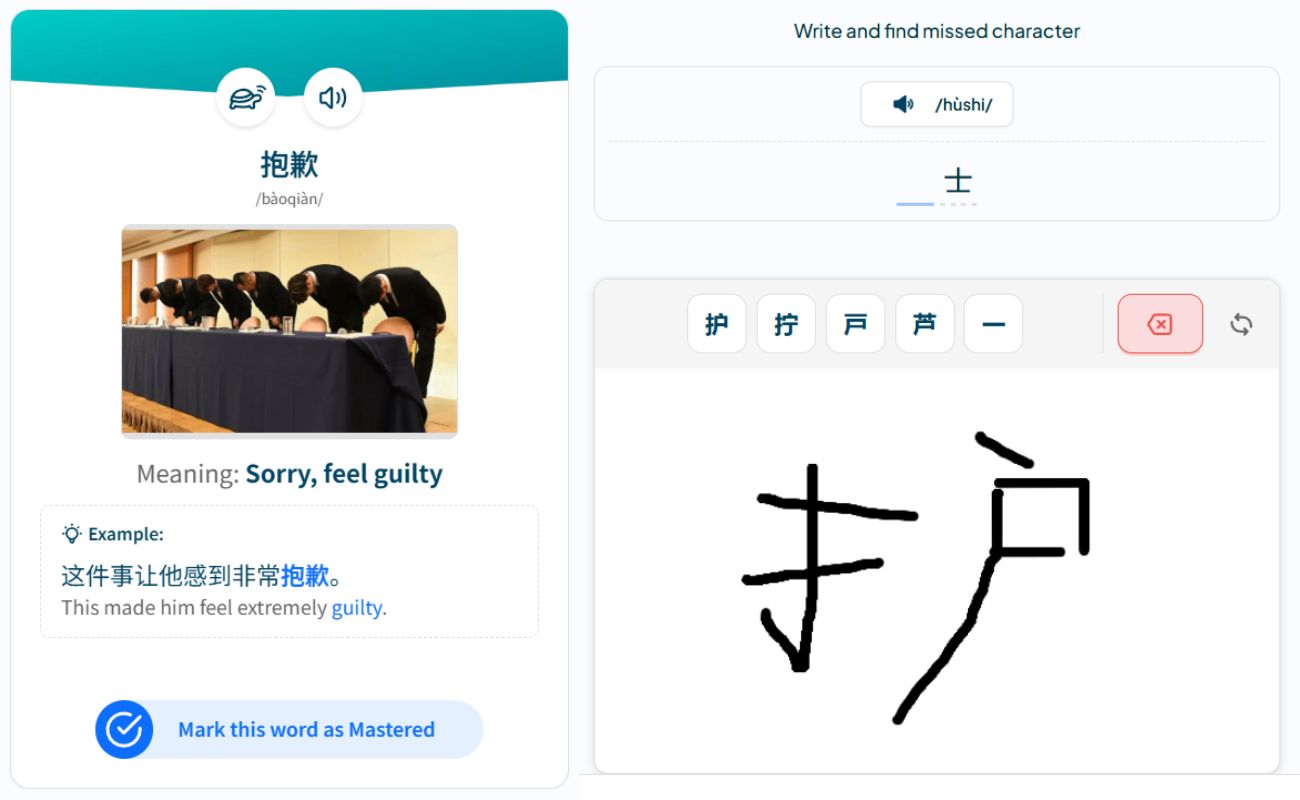
GuruLango brings Pinyin, audio, characters, meanings, and practice together, so you can learn Chinese in a way that feels clear, practical, and easier to keep up with.
Conclusion
So, what is Pinyin in real learning? It is the bridge that helps Mandarin sounds feel less distant and more usable from day one. Once you understand how Pinyin works with tones, pronunciation, and characters, Chinese becomes easier to approach step by step. Ready to build that foundation? Start with GuruLango and learn Chinese with Pinyin, audio, characters, and real examples from the beginning.
FAQ
1. Is Pinyin the Chinese alphabet?
No. Pinyin is not the Chinese alphabet. It is a romanization system that uses Latin letters to show how Mandarin words are pronounced. Chinese is still written with characters, not an alphabet.
2. Can you learn Chinese with only Pinyin?
You can use Pinyin to start speaking and understanding basic Mandarin sounds, but you cannot fully learn Chinese with Pinyin alone. To read and write Chinese properly, you still need to learn Chinese characters.
3. Do Chinese people use Pinyin every day?
Yes, but mostly for practical tasks, such as typing Chinese on phones or computers, looking up words, or teaching pronunciation. In daily reading and writing, Chinese people mainly use characters, not Pinyin.