






Overview Of The HSK 3 Vocabulary’s Exam
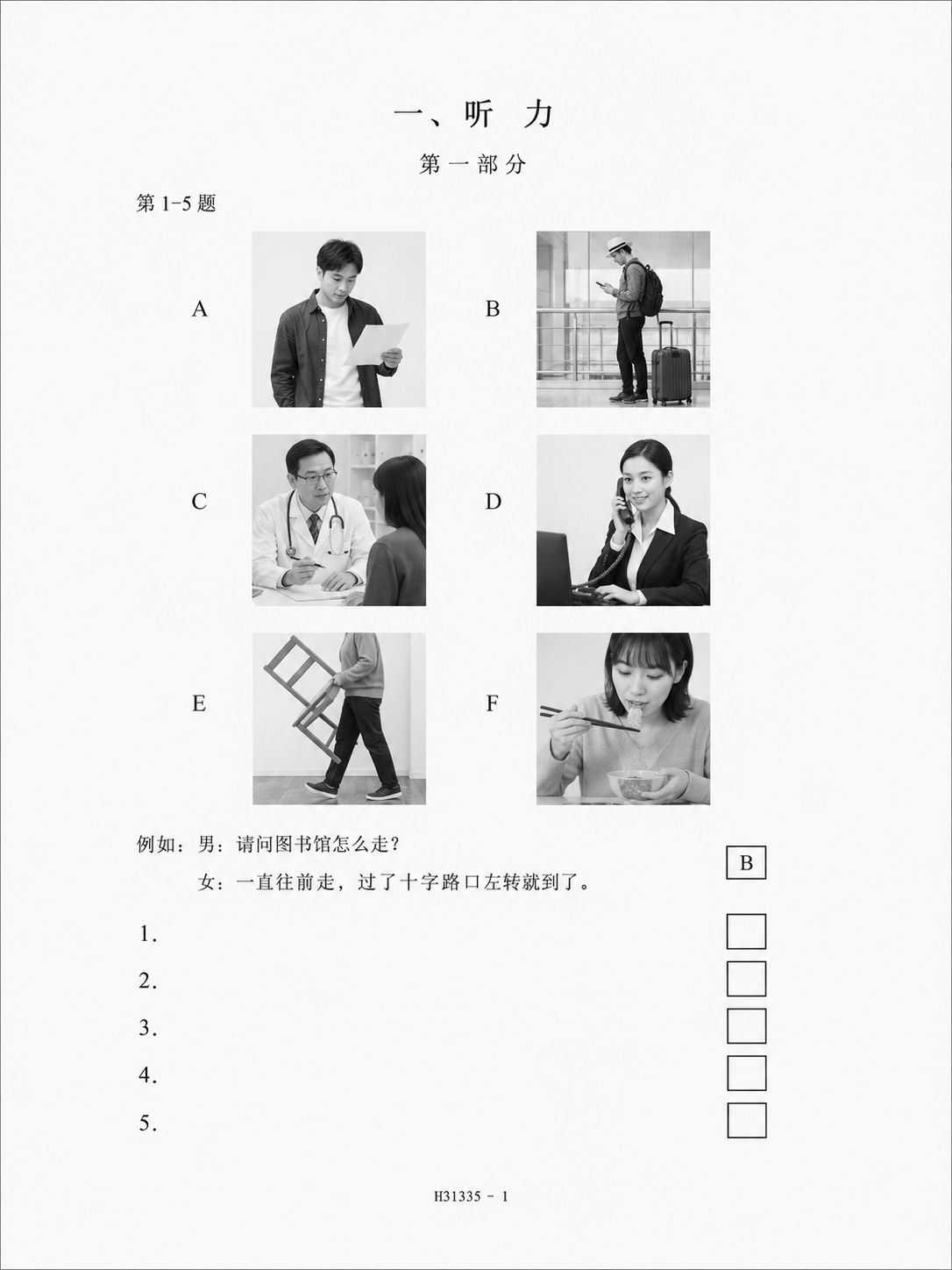
HSK 3 is the third level of the Hanyu Shuiping Kaoshi (HSK) that measures how well non-native speakers can use Chinese in everyday, academic, and professional contexts.
Under the new HSK 3.0, the written test contains 70 questions and lasts about 83 minutes, covering three core skills:
- Listening: 30 questions in about 23 minutes
- Reading: 30 questions in 30 minutes
- Writing: 10 questions in 20 minutes
HSK 3.0 also brings speaking into the assessment. During the current pilot, Level 3 candidates must take a separate 15-minute speaking test alongside the written exam.
Because HSK 3.0 is still being rolled out through pilot exams in 2026, its final passing-score policy has not yet been published. CTI currently confirms that pilot score reports are valid for two years, so candidates should check with their test center for the exact format and scoring rules before registering.
How Many Words Are In HSK 3?

The size of HSK 3 vocabulary depends on which version of the exam you are preparing for.
- Old HSK 2.0: 600 words in total, including 300 new HSK 3 words.
- New HSK 3.0: 1,000 words in total, including 500 new Level 3 words on top of the 500 words from Levels 1 and 2.
So, if you are studying for HSK 3.0, your immediate focus is the 500 new HSK 3 vocabulary words, but you are expected to recognize and use all 1,000 words accumulated across Levels 1-3.
Complete HSK 3 Vocabulary List
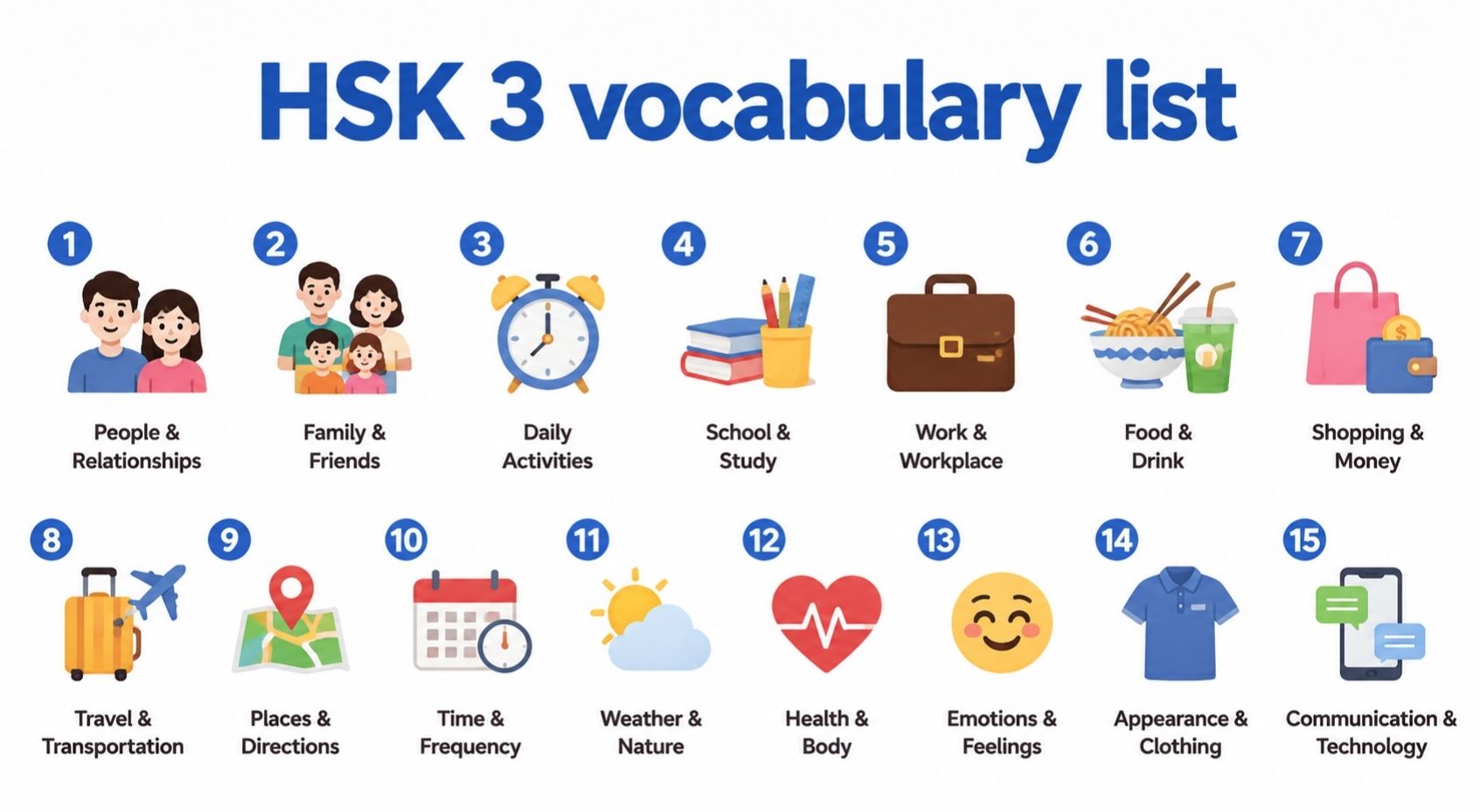
To make the list easier to learn and review, we’ve grouped the words into 15 practical topics you’ll actually use.
1. People & Relationships
A good place to begin is with the HSK 3 vocabulary you need to describe people, recognize them, and talk about how you connect with others.
| Chinese | Pinyin | Part of speech |
English meaning |
| 别人 | biérén | Pronoun | others; other people |
| 聪明 | cōngmíng | Adjective | smart; clever |
| 大人 | dàren | Noun | adult; grown-up |
| 关系 | guānxi | Noun | relationship; relation |
| 关心 | guānxīn | Verb | to care about; to be concerned about |
| 欢迎 | huānyíng | Verb | to welcome |
| 见面 | jiànmiàn | Verb | to meet; to see each other |
| 可爱 | kě’ài | Adjective | cute; lovable |
| 客人 | kèrén | Noun | guest; customer |
| 老人 | lǎorén | Noun | elderly person |
| 名人 | míngrén | Noun | famous person; celebrity |
| 男人 | nánrén | Noun | man |
| 男生 | nánshēng | Noun | male student; boy |
| 年轻 | niánqīng | Adjective | young |
| 女人 | nǚrén | Noun | woman |
| 女生 | nǚshēng | Noun | female student; girl |
| 认得 | rènde | Verb | to recognize; to know |
| 认真 | rènzhēn | Adjective | serious; conscientious |
| 咱们 | zánmen | Pronoun | we; us, including the listener |
2. Family & Friends
Next come the words you’ll need to talk naturally about family ties, close friends, and the moments you share with them.
| Chinese | Pinyin | Part of speech | English meaning |
| 爱人 | àiren | Noun | spouse |
| 阿姨 | āyí | Noun | aunt; auntie |
| 搬家 | bānjiā | Verb | to move house; to relocate |
| 夫妻 | fūqī | Noun | husband and wife; married couple |
| 过节 | guòjié | Verb | to celebrate a festival; to spend a holiday |
| 结婚 | jiéhūn | Verb | to get married |
| 姐妹 | jiěmèi | Noun | sisters |
| 聊天儿 | liáotiānr | Verb | to chat |
| 邻居 | línjū | Noun | neighbor |
| 礼物 | lǐwù | Noun | gift; present |
| 请客 | qǐngkè | Verb | to treat someone; to invite someone for a meal |
| 叔叔 | shūshu | Noun | uncle |
| 同意 | tóngyì | Verb | to agree; to consent |
| 养 | yǎng | Verb | to raise; to keep |
| 照顾 | zhàogù | Verb | to take care of; to look after |
| 做客 | zuòkè | Verb | to visit as a guest; to be a guest |
3. Daily Activities
For everyday routines, these HSK 3 vocabulary words cover everything from household tasks and habits to leisure activities.
| Chinese | Pinyin | Part of speech | English meaning |
| 常常 | chángcháng | Adverb | often; frequently |
| 打扫 | dǎsǎo | Verb | to clean; to sweep |
| 打算 | dǎsuàn | Verb; noun | to plan; plan |
| 关机 | guānjī | Verb | to turn off; to power off |
| 开机 | kāijī | Verb | to turn on; to power on |
| 马上 | mǎshàng | Adverb | immediately; right away |
| 拍照 | pāizhào | Verb | to take a photo |
| 平时 | píngshí | Noun | ordinary times; day-to-day life |
| 骑 | qí | Verb | to ride |
| 然后 | ránhòu | Conjunction | then; after that |
| 生活 | shēnghuó | Noun; verb | life; to live |
| 刷 | shuā | Verb | to brush; to scrub |
| 忘记 | wàngjì | Verb | to forget |
| 习惯 | xíguàn | Verb; noun | to be accustomed to; habit |
| 洗澡 | xǐzǎo | Verb | to bathe; to take a shower |
| 游戏 | yóuxì | Noun | game |
| 周末 | zhōumò | Noun | weekend |
4. School & Study
Moving into the classroom, this set brings together the words you need for lessons, study materials, and academic life.
| Chinese | Pinyin | Part of speech | English meaning |
| 班级 | bānjí | Noun | class; class group |
| 笔记 | bǐjì | Noun | notes |
| 笔记本 | bǐjìběn | Noun | notebook |
| 成绩 | chéngjì | Noun | grade; academic result |
| 迟到 | chídào | Verb | to be late |
| 词典 | cídiǎn | Noun | dictionary |
| 放学 | fàngxué | Verb | to finish school for the day |
| 复习 | fùxí | Verb | to review |
| 黑板 | hēibǎn | Noun | blackboard |
| 课本 | kèběn | Noun | textbook |
| 课文 | kèwén | Noun | lesson text; text |
| 练习 | liànxí | Verb; noun | to practice; practice |
| 留学 | liúxué | Verb | to study abroad |
| 年级 | niánjí | Noun | grade; school year |
| 数学 | shùxué | Noun | mathematics |
| 图书馆 | túshūguǎn | Noun | library |
| 外语 | wàiyǔ | Noun | foreign language |
| 校园 | xiàoyuán | Noun | campus |
| 学期 | xuéqī | Noun | semester; term |
| 作业 | zuòyè | Noun | homework |
5. Work & Workplace
This HSK 3 vocabulary set helps you handle common workplace topics, from meetings and managers to leave requests and emails.
| Chinese | Pinyin | Part of speech | English meaning |
| 办公室 | bàngōngshì | Noun | office |
| 参加 | cānjiā | Verb | to participate; to take part in |
| 服务 | fúwù | Verb | to serve; to provide a service |
| 干 | gàn | Verb | to do; to work |
| 工作日 | gōngzuòrì | Noun | workday; working day |
| 关注 | guānzhù | Verb | to follow; to pay attention to |
| 会议 | huìyì | Noun | meeting |
| 机会 | jīhuì | Noun | opportunity; chance |
| 解决 | jiějué | Verb | to solve; to resolve |
| 经理 | jīnglǐ | Noun | manager |
| 决定 | juédìng | Verb; noun | to decide; decision |
| 开会 | kāihuì | Verb | to hold or attend a meeting |
| 名单 | míngdān | Noun | list of names; list |
| 请假 | qǐngjià | Verb | to request leave; to ask for time off |
| 同事 | tóngshì | Noun | colleague; coworker |
| 完成 | wánchéng | Verb | to complete; to finish |
| 休假 | xiūjià | Verb | to take leave; to be on vacation |
| 需要 | xūyào | Verb; noun | to need; need |
| 要求 | yāoqiú | Verb; noun | to require; requirement; request |
| 邮件 | yóujiàn | Noun | email; mail |
6. Food & Drink
At the table, these words take you from choosing a dish to describing how it tastes.
| Chinese | Pinyin | Part of speech | English meaning |
| 饱 | bǎo | Adjective | full; not hungry |
| 冰激凌 | bīngjīlíng | Noun | ice cream |
| 菜单 | càidān | Noun | menu |
| 尝 | cháng | Verb | to taste; to try |
| 蛋糕 | dàngāo | Noun | cake |
| 饿 | è | Adjective | hungry |
| 方便面 | fāngbiànmiàn | Noun | instant noodles |
| 鸡 | jī | Noun | chicken |
| 酒 | jiǔ | Noun | alcohol; alcoholic drink |
| 渴 | kě | Adjective | thirsty |
| 筷子 | kuàizi | Noun | chopsticks |
| 矿泉水 | kuàngquánshuǐ | Noun | mineral water |
| 盘子 | pánzi | Noun | plate |
| 啤酒 | píjiǔ | Noun | beer |
| 勺子 | sháozi | Noun | spoon |
| 糖 | táng | Noun | sugar; candy |
| 甜 | tián | Adjective | sweet |
| 外卖 | wàimài | Verb; noun | takeout; food delivery |
| 新鲜 | xīnxiān | Adjective | fresh |
| 饮料 | yǐnliào | Noun | drink; beverage |
7. Shopping & Money
These HSK3 vocabulary words help you move beyond “buy” and “sell” to compare, choose, pay, and shop with more precision.
| Chinese | Pinyin | Part of speech | English meaning |
| 比较 | bǐjiào | Verb; preposition; adverb | to compare; compared with; relatively |
| 差 | chà | Adjective; verb | poor; bad; to differ |
| 差不多 | chàbuduō | Adjective; adverb | about the same; almost; roughly |
| 公斤 | gōngjīn | Measure word | kilogram |
| 换 | huàn | Verb | to change; to exchange; to replace |
| 角 | jiǎo | Measure word | jiao; one-tenth of a yuan |
| 斤 | jīn | Measure word | jin; 500 grams |
| 卡 | kǎ | Noun | card |
| 毛 | máo | Measure word | mao; one-tenth of a yuan |
| 信用卡 | xìnyòngkǎ | Noun | credit card |
| 选 | xuǎn | Verb | to choose; to select |
| 选择 | xuǎnzé | Verb | to choose; to select |
| 一共 | yígòng | Adverb | altogether; in total |
| 银行 | yínháng | Noun | bank |
| 银行卡 | yínhángkǎ | Noun | bank card |
8. Travel & Transportation
On the move, HSK 3 vocabulary covers the essentials for routes, tickets, luggage, transport, and delays.
| Chinese | Pinyin | Part of speech | English meaning |
| 宾馆 | bīnguǎn | Noun | hotel; guesthouse |
| 船 | chuán | Noun | boat; ship |
| 出发 | chūfā | Verb | to set off; to depart |
| 地图 | dìtú | Noun | map |
| 方向 | fāngxiàng | Noun | direction |
| 高铁 | gāotiě | Noun | high-speed rail; high-speed train |
| 红绿灯 | hóng-lǜdēng | Noun | traffic light |
| 护照 | hùzhào | Noun | passport |
| 检票 | jiǎnpiào | Verb | to check tickets |
| 辆 | liàng | Measure word | measure word for vehicles |
| 离开 | líkāi | Verb | to leave; to depart from |
| 路口 | lùkǒu | Noun | intersection; road junction |
| 马路 | mǎlù | Noun | road; street |
| 汽车 | qìchē | Noun | car; automobile |
| 起飞 | qǐfēi | Verb | to take off |
| 司机 | sījī | Noun | driver |
| 晚点 | wǎndiǎn | Verb | to be delayed; to run late |
| 行李 | xíngli | Noun | luggage |
| 游客 | yóukè | Noun | tourist; visitor |
| 自行车 | zìxíngchē | Noun | bicycle |
See also:
9. Places & Directions
From city streets to compass points, this set helps you describe places and locations with much more precision.
| Chinese | Pinyin | Part of speech | English meaning |
| 北 | běi | Noun | north |
| 北方 | běifāng | Noun | the north; northern region |
| 城市 | chéngshì | Noun | city |
| 到处 | dàochù | Adverb | everywhere; all around |
| 地点 | dìdiǎn | Noun | location; place |
| 地方 | dìfang | Noun | place; area |
| 东 | dōng | Noun | east |
| 东北 | dōngběi | Noun | northeast |
| 东方 | dōngfāng | Noun | the east; eastern region |
| 东南 | dōngnán | Noun | southeast |
| 附近 | fùjìn | Noun | nearby area; vicinity |
| 公园 | gōngyuán | Noun | park |
| 街 | jiē | Noun | street |
| 面前 | miànqián | Noun | in front of; before |
| 南 | nán | Noun | south |
| 南方 | nánfāng | Noun | the south; southern region |
| 西 | xī | Noun | west |
| 西北 | xīběi | Noun | northwest |
| 西南 | xīnán | Noun | southwest |
| 中间 | zhōngjiān | Noun | middle; between |
10. Time & Frequency
Time expressions keep conversation moving by showing what happened before, what comes next, and how often something occurs.
| Chinese | Pinyin | Part of speech | English meaning |
| 半天 | bàntiān | Numeral–measure phrase | half a day |
| 不久 | bùjiǔ | Adjective | not long; soon |
| 才 | cái | Adverb | only; not until; just |
| 常 | cháng | Adverb | often; frequently |
| 刚 | gāng | Adverb | just; only just |
| 刚才 | gāngcái | Noun | just now; a moment ago |
| 刚刚 | gānggāng | Adverb | just; just now |
| 过去 | guòqù | Noun | the past; former times |
| 后来 | hòulái | Noun | later; afterwards |
| 后年 | hòunián | Noun | the year after next |
| 后天 | hòutiān | Noun | the day after tomorrow |
| 久 | jiǔ | Adjective | long; for a long time |
| 前年 | qiánnián | Noun | the year before last |
| 前天 | qiántiān | Noun | the day before yesterday |
| 先 | xiān | Adverb | first; beforehand |
| 以后 | yǐhòu | Noun | after; later; in the future |
| 以前 | yǐqián | Noun | before; previously |
| 一直 | yìzhí | Adverb | continuously; all along |
| 总是 | zǒngshì | Adverb | always |
| 最近 | zuìjìn | Noun | recent period; recently |
11. Weather & Nature
From wind and sunshine to mountains and rivers, this HSK 3 vocabulary set keeps nature easy to talk about.
| Chinese | Pinyin | Part of speech | English meaning |
| 冰 | bīng | Noun | ice |
| 草 | cǎo | Noun | grass |
| 草地 | cǎodì | Noun | grassland; lawn |
| 春天 | chūntiān | Noun | spring |
| 大熊猫 | dàxióngmāo | Noun | giant panda |
| 冬天 | dōngtiān | Noun | winter |
| 动物 | dòngwù | Noun | animal |
| 风 | fēng | Noun | wind |
| 刮 | guā | Verb | to blow, of wind |
| 海 | hǎi | Noun | sea |
| 河 | hé | Noun | river |
| 环境 | huánjìng | Noun | environment; surroundings |
| 季节 | jìjié | Noun | season |
| 开花 | kāihuā | Verb | to bloom; to flower |
| 凉快 | liángkuai | Adjective | pleasantly cool |
| 秋天 | qiūtiān | Noun | autumn; fall |
| 山 | shān | Noun | mountain |
| 树 | shù | Noun | tree |
| 太阳 | tàiyáng | Noun | sun |
| 夏天 | xiàtiān | Noun | summer |
12. Health & Body
When health comes up, this HSK 3 vocabulary helps you talk clearly about the body, common illnesses, and basic care.
| Chinese | Pinyin | Part of speech | English meaning |
| 安全 | ānquán | Adjective | safe; secure |
| 病人 | bìngrén | Noun | patient; sick person |
| 查 | chá | Verb | to check; to examine |
| 出院 | chūyuàn | Verb | to be discharged from hospital |
| 锻炼 | duànliàn | Verb | to exercise |
| 耳朵 | ěrduo | Noun | ear |
| 发烧 | fāshāo | Verb | to have a fever |
| 干净 | gānjìng | Adjective | clean; neat |
| 感冒 | gǎnmào | Noun; verb | cold; to catch a cold |
| 检查 | jiǎnchá | Verb | to examine; to inspect |
| 健康 | jiànkāng | Adjective | healthy; in good health |
| 脚 | jiǎo | Noun | foot |
| 脸 | liǎn | Noun | face |
| 腿 | tuǐ | Noun | leg |
| 小心 | xiǎoxīn | Verb; adjective | to be careful; careful |
| 牙 | yá | Noun | tooth |
| 牙刷 | yáshuā | Noun | toothbrush |
| 住院 | zhùyuàn | Verb | to be hospitalized |
| 注意 | zhùyì | Verb | to pay attention to |
| 嘴 | zuǐ | Noun | mouth |
13. Emotions & Feelings
When “good” or “bad” is not enough, these words help you say what you actually feel.
| Chinese | Pinyin | Part of speech | English meaning |
| 安静 | ānjìng | Adjective | calm; peaceful; quiet |
| 担心 | dānxīn | Verb | to worry; to be worried |
| 感到 | gǎndào | Verb | to feel; to sense |
| 感兴趣 | gǎn xìngqù | Adjective | interested |
| 害怕 | hàipà | Verb | to be afraid; to feel scared |
| 急 | jí | Adjective; verb | anxious; urgent; in a hurry |
| 开心 | kāixīn | Adjective | happy |
| 满意 | mǎnyì | Verb | to be satisfied; to be pleased |
| 难过 | nánguò | Adjective | sad; upset |
| 怕 | pà | Verb; adverb | to be afraid; to fear |
| 奇怪 | qíguài | Adjective | strange; odd |
| 热情 | rèqíng | Adjective | enthusiastic; warm |
| 认为 | rènwéi | Verb | to think; to believe |
| 生气 | shēngqì | Verb | to get angry; to be angry |
| 喜爱 | xǐ’ài | Verb | to like; to love |
| 相信 | xiāngxìn | Verb | to believe; to trust |
| 心里 | xīnlǐ | Noun | heart; mind; inner thoughts |
| 兴趣 | xìngqù | Noun | interest; hobby |
| 愿意 | yuànyì | Verb | to be willing; to want |
| 着急 | zháojí | Adjective | worried; anxious |
14. Appearance & Clothing
Whether you are trying something on or describing a person, this HSK 3 vocabulary covers the details you are most likely to need.
| Chinese | Pinyin | Part of speech | English meaning |
| 矮 | ǎi | Adjective | short; low |
| 衬衫 | chènshān | Noun | shirt; blouse |
| 大小 | dàxiǎo | Noun | size; dimensions |
| 大衣 | dàyī | Noun | overcoat; coat |
| 短 | duǎn | Adjective | short |
| 短裤 | duǎnkù | Noun | shorts |
| 合适 | héshì | Adjective | suitable; a good fit |
| 难看 | nánkàn | Adjective | unattractive; ugly |
| 胖 | pàng | Adjective | fat; plump |
| 裙子 | qúnzi | Noun | skirt |
| 上衣 | shàngyī | Noun | top; upper garment |
| 身高 | shēngāo | Noun | height |
| 试 | shì | Verb | to try; to try on |
| 瘦 | shòu | Adjective | thin; slim |
| 双 | shuāng | Measure word | pair; measure word for paired items |
| 头发 | tóufa | Noun | hair |
| 像 | xiàng | Verb; adverb; noun | to resemble; to be like |
| 鞋 | xié | Noun | shoe |
| 脏 | zāng | Adjective | dirty |
15. Communication & Technology
By this point, communication moves beyond face-to-face conversation to messages, media, websites, and the tools we use every day.
| Chinese | Pinyin | Part of speech | English meaning |
| 报纸 | bàozhǐ | Noun | newspaper |
| 电子书 | diànzǐshū | Noun | e-book |
| 对话 | duìhuà | Verb | to converse; to have a dialogue |
| 耳机 | ěrjī | Noun | earphones; headphones |
| 发 | fā | Verb | to send; to issue |
| 回答 | huídá | Verb | to answer; to reply |
| 讲 | jiǎng | Verb | to speak; to tell; to explain |
| 节目 | jiémù | Noun | program; show |
| 聊 | liáo | Verb | to chat |
| 声音 | shēngyīn | Noun | sound; voice |
| 收到 | shōudào | Verb | to receive |
| 听说 | tīngshuō | Verb | to hear; to be told |
| 网站 | wǎngzhàn | Noun | website |
| 相机 | xiàngjī | Noun | camera |
| 信 | xìn | Verb; noun | to believe; letter |
| 新闻 | xīnwén | Noun | news |
| 邮箱 | yóuxiāng | Noun | mailbox; email inbox |
| 语言 | yǔyán | Noun | language |
| 照片 | zhàopiàn | Noun | photo; photograph |
| 照相 | zhàoxiàng | Verb | to take a photo |
How To Learn HSK 3 Vocabulary Effectively
The fastest way to make new words stick is to stop treating them as a list and start using them in your everyday Chinese.
- Use flashcards for active recall. Study 10-15 new words at a time, and try to recall their meanings and pinyin before revealing the answers. Review difficult cards more often instead of restarting the whole deck.
- Learn by topic. Study related words together (food, travel, or work) so each word has a clear context and is easier to retrieve when you need it.
- Put every new word into a sentence. One short, natural sentence is enough. For example, after learning 晚点 (wǎndiǎn), write something like 火车晚点了 rather than memorizing “be delayed” in isolation.
- Mix old and new vocabulary. A useful review set might contain 10 new words and 20 words from previous sessions. This keeps earlier vocabulary active while your word bank grows.
- Test yourself every week. Pull 30-50 random words and check whether you can recognize, pronounce, and use them without looking at your notes.
Don’t let these words stay on the page. Learn Chinese on GuruLango and turn what you’ve just learned into vocabulary you can actually remember and use.
Conclusion
HSK 3 vocabulary is much easier to master when every word has context and every review has a purpose. Keep learning by topic, revisit words regularly, and use them in real sentences. With steady practice on GuruLango, those words can quickly become part of the Chinese you understand and use with confidence.