






I. Number in Chinese from 0 to 1000
Let’s count!
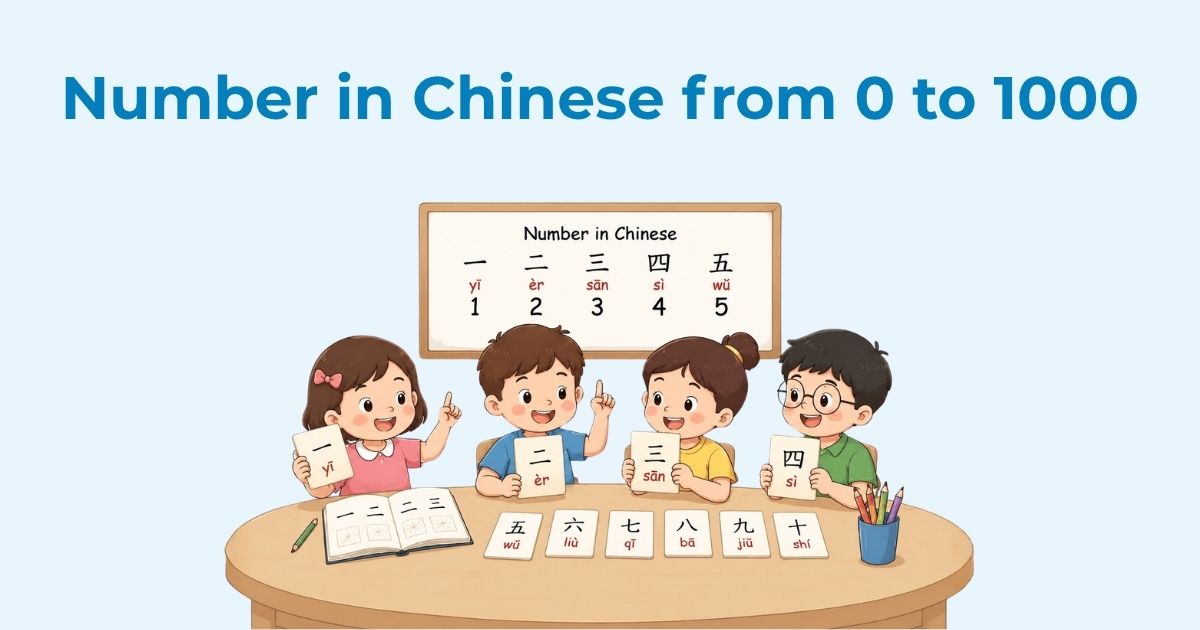
1. Chinese numbers 0-9
Let’s make Chinese numbers easy from the start. When you learn Chinese, 0 to 9 is the first pattern you should understand.
| Number | Hanzi | Pinyin | English |
| 0 | 零 / 〇 | líng | zero |
| 1 | 一 | yī | one |
| 2 | 二 | èr | two |
| 3 | 三 | sān | three |
| 4 | 四 | sì | four |
| 5 | 五 | wǔ | five |
| 6 | 六 | liù | six |
| 7 | 七 | qī | seven |
| 8 | 八 | bā | eight |
| 9 | 九 | jiǔ | nine |
零 is the standard form, while 〇 is often used when numbers are read digit by digit, such as in phone numbers or dates.
The first three numbers are easy to remember because 一, 二, 三 look like one, two, and three horizontal lines. After that, you only need a little practice.
2. Chinese numbers 10-99
Now that you know 0 to 9, Chinese numbers from 10 to 99 become much easier. You do not need to memorize every single number in Chinese. You only need to understand the pattern.
The key character here is 十 (shí), which means “ten”.
For numbers from 10 to 19, the pattern is:
十 + number
| Number | Hanzi | Pinyin | English |
| 10 | 十 | shí | ten |
| 11 | 十一 | shí yī | eleven |
| 12 | 十二 | shí èr | twelve |
| 13 | 十三 | shí sān | thirteen |
| 14 | 十四 | shí sì | fourteen |
| 15 | 十五 | shí wǔ | fifteen |
| 16 | 十六 | shí liù | sixteen |
| 17 | 十七 | shí qī | seventeen |
| 18 | 十八 | shí bā | eighteen |
| 19 | 十九 | shí jiǔ | nineteen |
For 20, 30, 40, and the other tens, the pattern changes slightly:
number + 十
| Number | Hanzi | Pinyin | English |
| 20 | 二十 | èr shí | twenty |
| 30 | 三十 | sān shí | thirty |
| 40 | 四十 | sì shí | forty |
| 50 | 五十 | wǔ shí | fifty |
| 60 | 六十 | liù shí | sixty |
| 70 | 七十 | qī shí | seventy |
| 80 | 八十 | bā shí | eighty |
| 90 | 九十 | jiǔ shí | ninety |
For the numbers in between, just add the final digit after the ten.
tens + ones
- 21 = 二十一 = èr shí yī
- 35 = 三十五 = sān shí wǔ
- 48 = 四十八 = sì shí bā
- 72 = 七十二 = qī shí èr
- 99 = 九十九 = jiǔ shí jiǔ
This is where number in Chinese start to feel very logical. Once you know 一 to 九 and understand how 十 works, you can read and say almost every number from 10 to 99 with the same simple pattern.
3. Chinese numbers 100-1000
After 99, you only need one new word: 百 (bǎi), which means “hundred”. To say hundreds in Chinese, use this pattern:
number + 百
| Number | Hanzi | Pinyin | English |
| 100 | 一百 | yī bǎi | one hundred |
| 200 | 二百 | èr bǎi | two hundred |
| 300 | 三百 | sān bǎi | three hundred |
| 400 | 四百 | sì bǎi | four hundred |
| 500 | 五百 | wǔ bǎi | five hundred |
| 600 | 六百 | liù bǎi | six hundred |
| 700 | 七百 | qī bǎi | seven hundred |
| 800 | 八百 | bā bǎi | eight hundred |
| 900 | 九百 | jiǔ bǎi | nine hundred |
| 1000 | 一千 | yī qiān | one thousand |
To build numbers between 100 and 1000, place the hundreds, tens, and ones in order.
hundreds + tens + ones
- 118 = 一百一十八 = yī bǎi yī shí bā
- 245 = 二百四十五 = èr bǎi sì shí wǔ
- 376 = 三百七十六 = sān bǎi qī shí liù
- 999 = 九百九十九 = jiǔ bǎi jiǔ shí jiǔ
When there is a zero in the middle, use 零 (líng) to show the missing place.
- 101 = 一百零一 = yī bǎi líng yī
- 205 = 二百零五 = èr bǎi líng wǔ
- 609 = 六百零九 = liù bǎi líng jiǔ
II. Practical applications of Chinese numbers
Now that you know how to read and write Chinese numbers, let’s look at some everyday situations where you’ll use them.
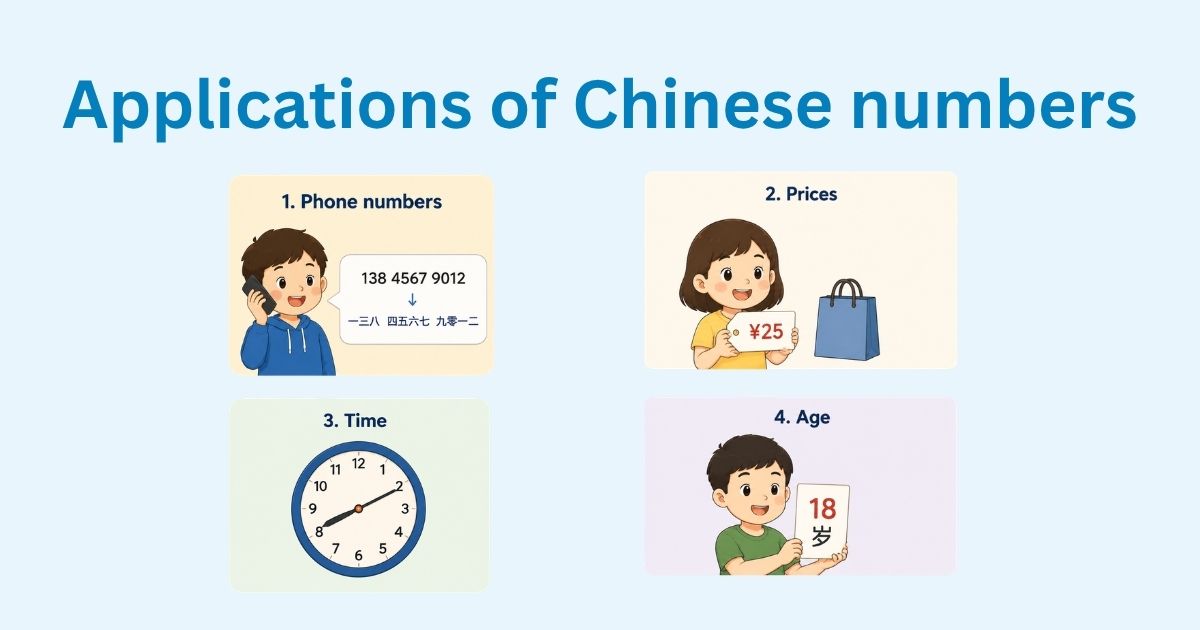
1. Phone numbers
In Chinese, phone numbers are read digit by digit. It’s just like saying individual number in English, so once you know your Chinese digits, you’re good to go.
For example, a number like 138 4567 9012 would be read as 一三八 四五六七 九零一二 (Yī sān bā, sì wǔ liù qī, jiǔ líng yī èr)
Notice how 一 (yī) is often pronounced as 幺 (yāo) in phone numbers to avoid confusion. So 101 is pronounced 幺零幺 (yāo líng yāo).
2. Prices
When talking about prices, 元 (yuán) is the standard word for yuan, while 块 (kuài) is more common in everyday speech. They’re pretty much interchangeable.
For example:
- ¥10 = 十元 / 十块
Shí yuán / shí kuài - ¥25 = 二十五元 / 二十五块
Èr shí wǔ yuán / èr shí wǔ kuài
You may also hear 毛 (máo) or 角 (jiǎo) for one-tenth of a yuan. For example: ¥3.50 = 三块五 (Sān kuài wǔ)
3. Time
To tell the time in Chinese, use 点 (diǎn) for “o’clock” and 分 (fēn) for minutes.
The basic pattern is:
hour + 点 + minutes + 分
For example:
- 3:00 = 三点
Sān diǎn - 3:15 = 三点十五分
Sān diǎn shí wǔ fēn - 8:30 = 八点半
Bā diǎn bàn (半, bàn, means “half”)
- 8:45 = 八点四十五分
Bā diǎn sì shí wǔ fēn
4. Age
To ask someone’s age or talk about your own, use 岁 (suì), which means “years old.”
For example:
- 18 = 十八岁
Shí bā suì - 25 = 二十五岁
Èr shí wǔ suì
To ask someone’s age, you can say:
- 你几岁?
Nǐ jǐ suì? (for younger people or kids) - 你多大?
Nǐ duō dà? (for adults)
Read more: How to say how old are you in Chinese
III. Fun Chinese number slang and expressions
Once you know how to count, number in Chinese become even more interesting: Chinese slang. Some of them show up in texts, jokes, love messages, and even lucky wishes.
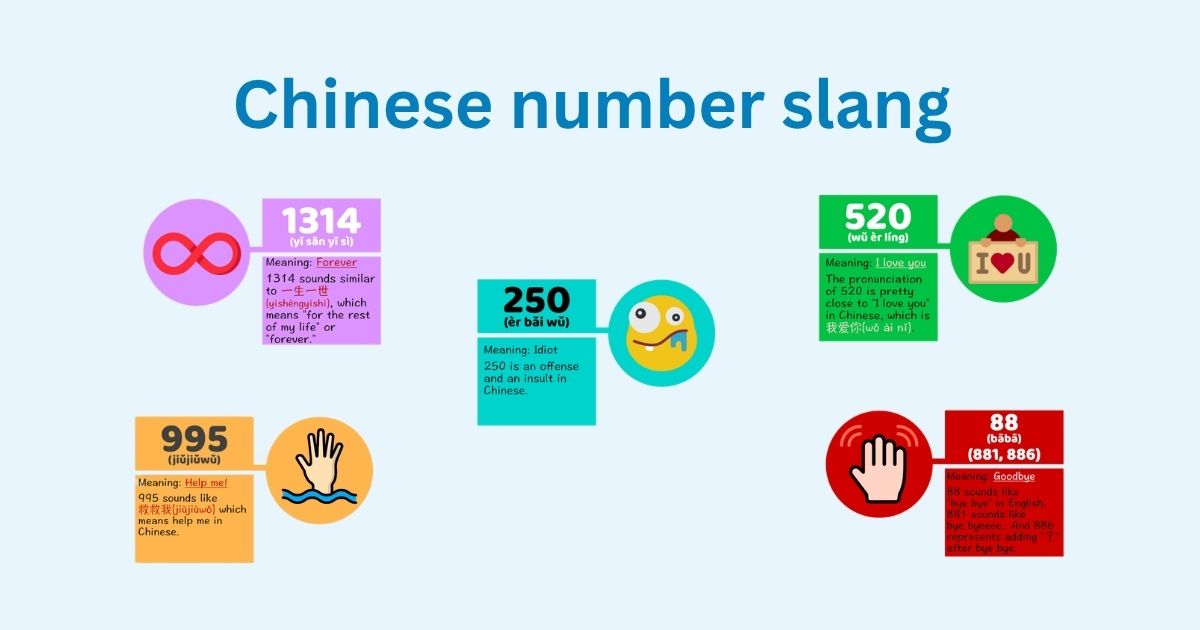
- 8 (八): 8 is considered a lucky number in Chinese culture. Why? Because the word 八 (bā) sounds like the word for wealth or prosperity, 发 (fā). That’s why people love to have phone numbers, license plates, or even addresses with lots of 8s in them.
- 520 (五二零): This one’s a fan favorite! Its pronunciation wǔ èr líng sounds similar to 我爱你 (wǒ ài nǐ), meaning “I love you”. It’s commonly used in texting or messaging as a shorthand way to say “I love you”.
- 250 (二百五): This one is a common slang term for someone foolish or not thinking clearly. So learners mainly need to remember that it can sound rude when used to describe a person.
- 1314 (一三一四): 1314 sounds like “一生一世” (yī shēng yī shì), which means “forever” or “for life”. It’s used to express eternal love, perfect for couples!
- 88 (八八): If you see 88, think of it as “bye-bye”. The number 8 (八), pronounced bā, sounds like “bye” when repeated. So, 88 is a casual, friendly way to say goodbye.
IV. Common mistakes when learning numbers in Chinese
Chinese numbers are logical, but beginners still make a few common mistakes. The good news is that most of them are easy to fix once you know what to watch for.
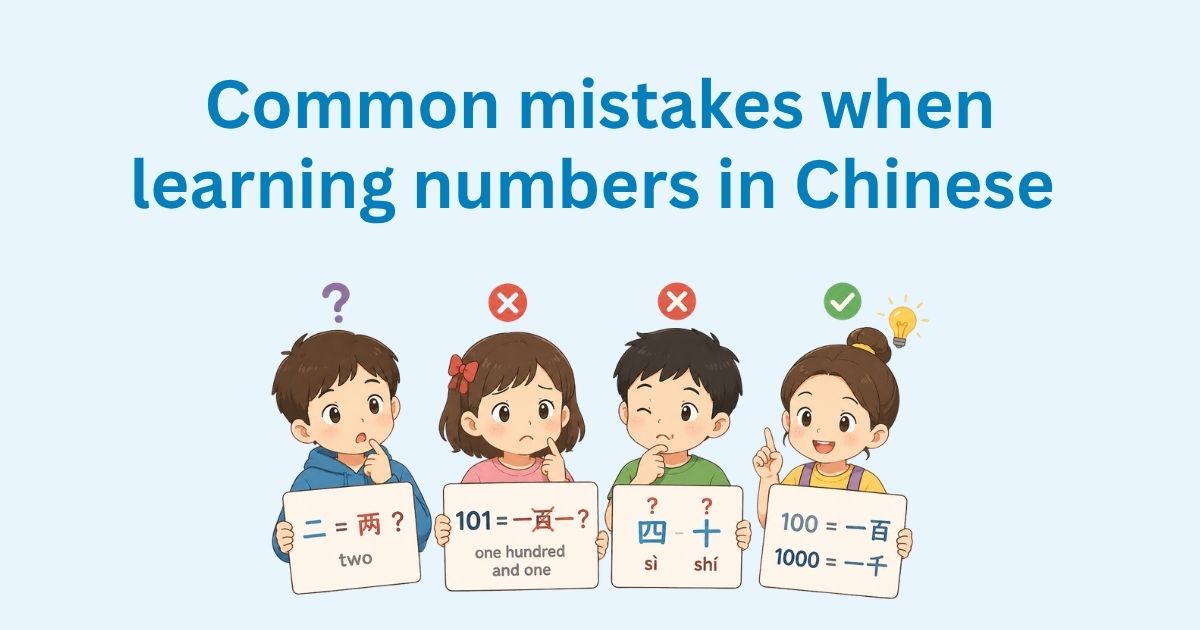
- Confusing 二 (èr) and 两 (liǎng): Both can mean “two”, but they are used differently. 二 is used when counting or reading numbers, while 两 is often used before measure words or nouns.
For example: 二十二 means “22”, but 两个苹果 means “two apples”. - Forgetting 零 (líng) in numbers with a zero: When a zero appears in the middle of a number, Chinese often uses 零 to mark the missing place.
For example, 101 is 一百零一, not 一百一. - Ignoring tones when saying Chinese numbers: Tones matter, even with short words. For example, 四 (sì) means four, while 十 (shí) means ten. They can sound close to beginners, so it is worth practicing them carefully.
- Translating number patterns directly from English: Chinese has its own number logic. Once you understand words like 十, 百, and 千, do not translate from English word by word.
Conclusion
Chinese numbers are not hard once the pattern clicks. From 0 to 1000, you only need a few key words like 十, 百, and 千 to build the rest. Keep practicing with Gurulango, and Chinese numbers will soon feel simple and natural.
FAQs
1. Is two in Chinese Er 二 or Liang 两?
Both 二 (èr) and 两 (liǎng) mean “two”. Use 二 for counting and reading numbers, such as 二十 (20) or 十二 (12). Use 两 before nouns or measure words, such as 两个苹果 — two apples.
2. Why is 250 avoided in Chinese?
In Chinese, 250 is 二百五 (èr bǎi wǔ). It can be used as slang for someone foolish or silly. The number is fine when talking about prices or quantities. But when used to describe a person, it can sound rude.
3. How do you write large numbers in Chinese?
Large numbers in Chinese use units like 十 (ten), 百 (hundred), 千 (thousand), 万 (ten thousand), and 亿 (hundred million). For example, 10,000 is 一万, 100,000 is 十万, and 100,000,000 is 一亿.